







A practical guide to MBBR media filling ratios: definitions, the fluidization limit behind the 67% ceiling, recommended ranges for municipal and industrial plants, and adjustment tips covering tank type, aeration, and regional water quality.
Introduction
The filling ratio (also written as filling rate or fill percentage) is one of the most frequently asked parameters in MBBR design:
set it too low and treatment capacity may fall short; set it too high and fluidization can be impaired.
In engineering practice, the filling ratio of MBBR media is generally controlled within 25%–67% (depending on media type and tank configuration), with noticeably different recommended ranges for municipal and industrial applications.
What Is the Filling Ratio and Why 67% Is Often Treated as the Ceiling
The filling ratio is the percentage of the reactor's effective volume occupied by the settled volume of the media. It determines both the total amount of media available for biofilm growth and whether the media can tumble freely under hydraulic and aeration forces.
In real projects, the filling ratio is measured on the basis of the media's settled volume: a media sample is loaded into a graduated cylinder or calibrated container, gently tapped until the volume stabilizes, and then compared with the tank volume. Dimensional variation between batches can affect the measurement, so design, procurement, and dosing should be calculated against the same batch specification wherever possible.
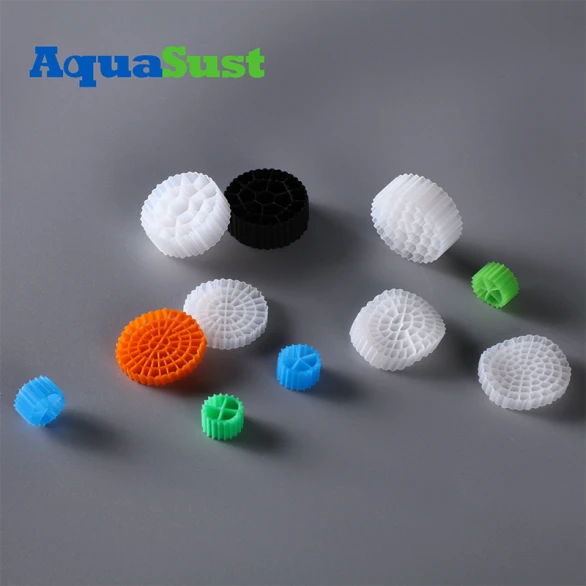
Fluidization requires sufficient free space. For cylindrical K-type media (K1/K3/K5), engineering experience shows that once the filling ratio exceeds roughly 67%, the media layer approaches dense packing: water and air bubbles struggle to penetrate, and stagnant zones tend to form near the tank bottom. For this reason, 67% is widely treated as the practical engineering ceiling for suspended media (typical value). The ceiling varies somewhat with media structure; porous sponge-type media deform more readily and can approach higher ratios in some scenarios, but this must be verified carefully.
Effects of a Filling Ratio That Is Too Low or Too High
2.1 Filling ratio too low
The effective biofilm surface area in the tank is insufficient, the volumetric loading rate drops, and effluent indicators become difficult to meet;
At low media concentrations, fluidization becomes overly vigorous, biofilm is more easily sheared off, and the biofilm establishment period is extended;
The investment in tank volume is not fully utilized - retrofit projects spend money without actually increasing capacity;
New-build projects may be forced to enlarge the tanks to compensate for treatment capacity, raising civil-construction and footprint costs.
2.2 Filling ratio too high
Media fluidization is restricted, packed dead zones develop inside the tank, mass transfer deteriorates, and localized oxygen deficiency appears;
Aeration energy consumption rises: more air is needed to maintain fluidization, increasing the unit treatment cost;
Collision and abrasion between media intensify, placing a higher load on retention screens, while service life shortens and maintenance pressure grows.
A common misconception in real projects is that "a higher filling ratio always means higher treatment capacity." When the ratio approaches the fluidization ceiling, adding more media does not improve removal rates and can actually worsen effluent quality.
2.3 How to judge on site whether the filling ratio is appropriate
During operation, three quick checks help: first, visually inspect the fluidization state - the media should tumble uniformly across the tank surface with no obvious packed zones; second, monitor dissolved oxygen distribution - large DO deviations across the tank indicate poor mixing, which may point to an overfilled tank; third, track effluent indicators and biofilm thickness - if the biofilm is persistently thin or sloughs frequently, the filling ratio or aeration rate may need adjustment. These are operating-experience checks; the final judgment always rests on water-quality test data.

Recommended Filling Ratios for Municipal and Industrial Scenarios
The recommended range for each scenario depends on influent concentration, the target effluent standard, tank type, and aeration method. The ranges below are typical engineering values; every specific project should be confirmed by design calculation.
|
Scenario |
Typical filling ratio |
Notes |
|
Municipal wastewater (new-build MBBR) |
30%–45% |
Normal-strength influent; balances nitrogen removal and fluidization |
|
Municipal activated-sludge retrofit (hybrid) |
25%–40% |
Media coexists with sludge; mixing space must be preserved |
|
Industrial wastewater (high COD: food/beverage/pulp & paper) |
40%–60% |
High load; strengthened mass transfer and aeration required |
|
Industrial wastewater (high ammonia: chemical/leachate) |
50%–67% |
Aims at surface-area loading; fluidization must be strictly verified |
|
MBBR + MBR combined process |
30%–50% |
Typical value for the upstream MBBR stage |
Note that the recommended ranges are only a starting point. The final value should be checked against the design volumetric loading rate (municipal typical 0.3–0.8 kg COD/(m³·d)) and the target effluent standard: for high load and strict standards, take the upper end of the range; for low load and energy-saving priorities, take the lower end.
Adjustments by Tank Type, Aeration, and Regional Water Quality
Tank type:
- plug-flow tanks develop large concentration gradients along the flow path, so their filling ratios are often lower than those of completely mixed tanks;
- multi-channel tanks can apply different filling ratios in different channels.
- Loading check: after selecting a filling ratio, verify both volumetric loading and surface-area loading to confirm that tank volume and media surface area each meet the design targets - avoid satisfying one indicator while exceeding the other.
Aeration method:
- European projects commonly use blower aeration with fine-bubble diffusers, which can support higher filling ratios (40%–55%);
- surface aerators or jet aeration provide limited mixing intensity, so the lower end of the range is recommended.
Regional water quality:
- in Southeast Asia, warm high-turbidity influent can easily coat the media with suspended solids; 25%–40% is suggested together with strengthened pretreatment.
- In cold northern regions, biological activity declines, so higher filling ratios are often used to compensate for surface area, combined with temperature-corrected design.
- In the EU, where influent concentrations are low, the filling ratio can be moderately reduced to save energy provided effluent standards are still met.
Compliance and delivery:
- for exported media, CE/REACH (EU) or EPA-related documentation must be provided for the target market;
- for projects in China, GB standards and applicable design codes apply, and the filling ratio is finalized through design verification.
Retrofit projects should also evaluate the surplus capacity of the existing aeration system to avoid insufficient aeration after the filling ratio is increased.

Frequently Asked Questions (FAQ)
Q1: Does a higher filling ratio always mean higher treatment capacity?
A: Not necessarily. Within the range where fluidization remains normal (e.g., 25%–50%), increasing the filling ratio adds effective biofilm surface area and capacity rises accordingly; but near 60%–67% fluidization becomes restricted, dead zones increase, capacity growth slows or reverses, and aeration energy consumption rises noticeably.
Q2: Why do so many designs cap the filling ratio at 67%?
A: It is an engineering rule of thumb (typical value) derived from the fluidization mechanism of suspended cylindrical media. Above this ratio, the water and air channels between media are compressed, making uniform fluidization difficult to maintain. If a project truly needs higher media density, the tank configuration or process combination should be re-evaluated rather than simply adding more media.
Q3: How should a retrofit project determine its filling ratio?
A: Retrofit projects are constrained by both the existing tank volume and the aeration system's capacity. First verify whether the current aeration supply can sustain fluidization and oxygen transfer at the target filling ratio, then run trial calculations within the recommended range; if necessary, validate biofilm attachment and removal rates in a pilot test before scaling up to the engineering value.
Conclusion
There is no one-size-fits-all filling ratio. A sound value equals scenario loading requirements plus tank/aeration capacity constraints plus regional water-quality corrections. Municipal projects commonly operate at 25%–50%, while high-load industrial scenarios may reach 60%–67% - the core criterion is whether the media can maintain normal fluidization.
For filling-ratio recommendations based on your specific water quality and tank conditions, contact the AquaSust technical team for a tailored proposal.