






Introduction
The Moving Bed Biofilm Reactor (MBBR) has become one of the most reliable biological wastewater treatment technologies worldwide - valued for its high efficiency, shock-load resistance, and stable long-term performance in both municipal and industrial applications.
Yet even seasoned engineers encounter recurring questions during MBBR media commissioning and operation. This guide compiles 8 of the most frequently asked questions from real engineering projects, covering everything from biofilm startup timelines to low-temperature performance and media fill ratios.
Whether you are commissioning a new system or troubleshooting an existing one, these answers - grounded in field experience - will help you optimize your MBBR process with confidence.
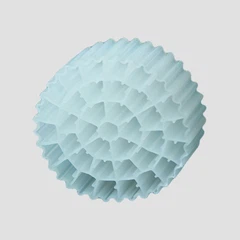
Figure 1: Typical MBBR biofilm carrier media (K-type cylindrical carriers) suspended in an aerated reactor. The protected inner surface area maximizes biofilm attachment.
Q1: How Long Does MBBR Media Take to Develop Biofilm in Cold Winter Conditions?
Short answer: Visible biofilm within 7 days; effluent compliance within 30 days; full biological maturity after one full seasonal cycle.
Biofilm startup on MBBR media is a three-stage process that engineers should track separately:
|
Stage |
Timeframe (Winter) |
Observable Indicator |
|
1. Visible biofilm formation |
~7 days |
Thin slime layer visible on media surface |
|
2. Effluent compliance |
Within 30 days |
Discharge standards met |
|
3. Full biological maturity |
1 full seasonal cycle (winter → summer) |
Stable, diverse microbial community |
Why does full maturity take a full seasonal cycle? From a microbiological perspective, complete biofilm maturation requires the media to host a diverse microbial community - including slow-growing nitrifiers and specialized denitrifiers - that stabilizes only after experiencing both low-temperature winter suppression and warm-season peak metabolic activity. Only after passing through this cycle can the biofilm community be considered truly stable.
Engineering Takeaway: For project scheduling purposes, budget 30 days to achieve compliant effluent in winter commissioning. Do not evaluate system performance based on biofilm appearance alone.
Q2: Does MBBR Require the Addition of Commercial Biological Cultures (Inoculants)?
Short answer: Generally no - not for municipal wastewater. May be beneficial in specific industrial wastewater applications.
MBBR media is specifically designed to naturally enrich indigenous microbial populations through optimized fluidization and carrier surface structure. Under normal conditions:
- Nitrifying bacteria (ammonia oxidizers) will self-colonize in aerobic zones
- Denitrifying bacteria will establish in anoxic zones
- Anaerobic ammonia oxidation (Anammox) bacteria can attach under low-oxygen conditions
The carrier's protected inner surface creates microenvironments that favor slow-growing specialists - making artificial seeding unnecessary for most domestic wastewater streams.
When might inoculant addition be considered?
- Recalcitrant (difficult-to-degrade) industrial wastewater with limited biodiversity
- Highly specific substrate wastewater (e.g., single-carbon-source streams)
- Research-grade projects exploring specialized degradation pathways
In these cases, a one-time inoculant dosing during initial startup can accelerate colonization - but continued dosing is not required once the biofilm is established.
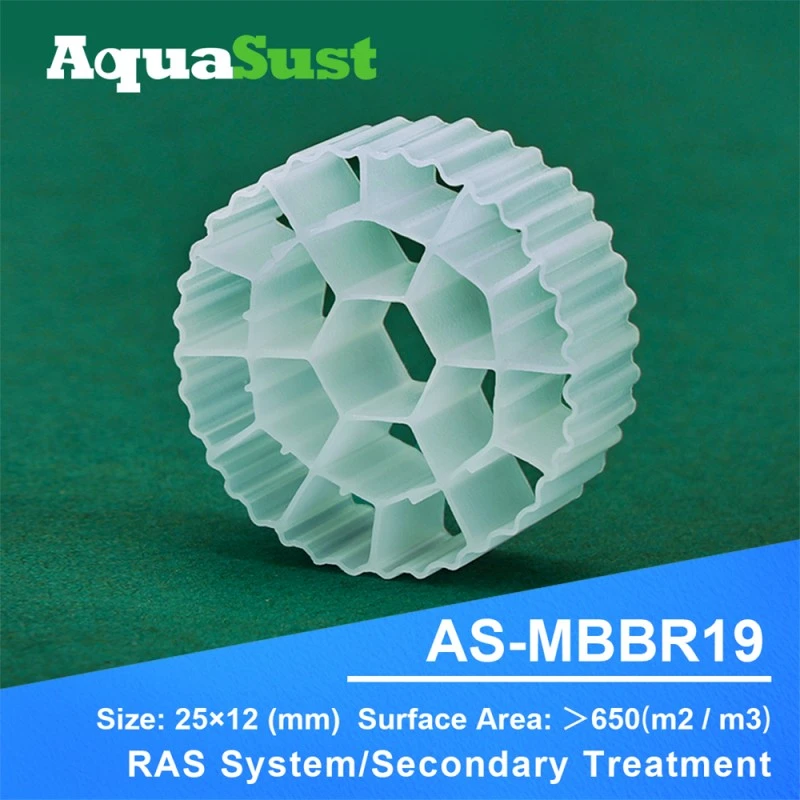
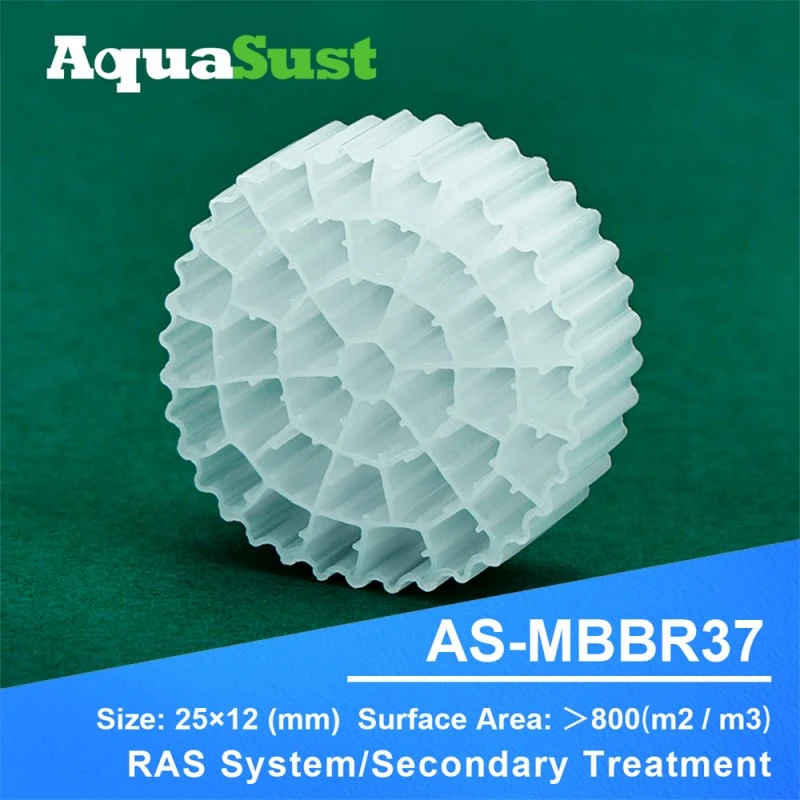
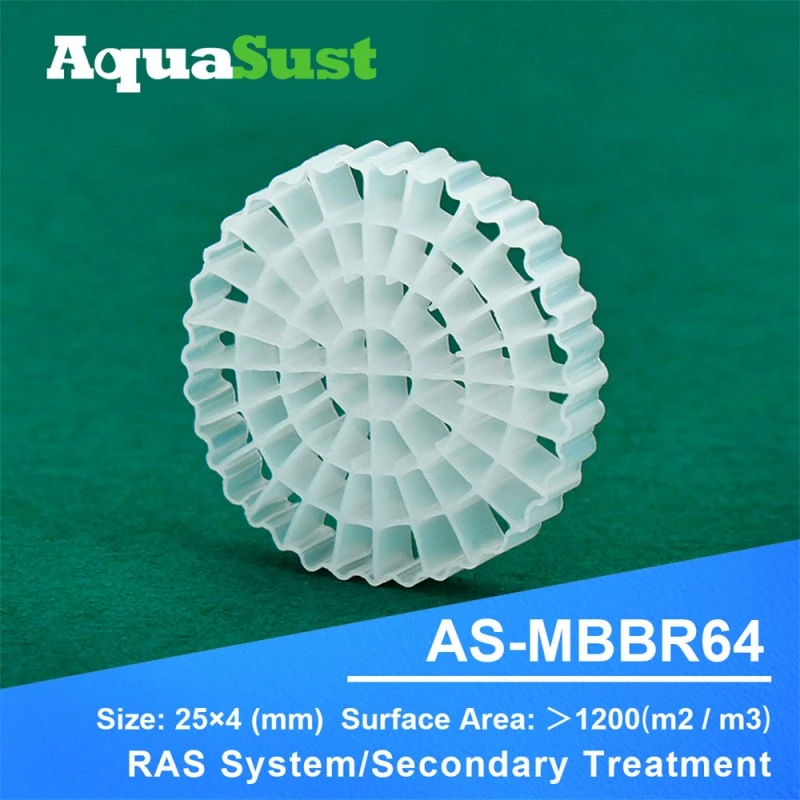
Figure 2: Aquasust AS-MBBR series carriers showing the progression of biofilm development. High inner surface area accelerates natural microbial colonization without inoculant addition.
Q3: Does MBBR Media Require Backwashing?
Short answer: No - backwashing is not required. MBBR media is self-regulating through natural biofilm sloughing.
This is one of the most significant operational advantages of MBBR over conventional fixed-film systems (e.g., trickling filters, submerged fixed biofilm reactors).
The self-regulating mechanism works as follows:
Active biofilm phase:
1. High metabolic activity → abundant extracellular polymeric substances (EPS) → strong biofilm adhesion
Aging biofilm phase:
2. Metabolic activity decreases → EPS secretion declines → biofilm adhesion weakens
Natural sloughing:
3. Weakened biofilm detaches during carrier fluidization → fresh surface exposed for new biofilm growth
This cycle is continuous and self-balancing. The fluidized motion of the carriers driven by aeration naturally controls biofilm thickness without operator intervention.
Operational Note: Unlike fixed-bed biofilm systems that require scheduled backwash cycles to remove excess biomass, MBBR systems eliminate this maintenance requirement - reducing both downtime and operational complexity.
Q4: What Are the Two Core Elements of a Successful MBBR System?
The two non-negotiable elements are: (1) the MBBR media itself, and (2) proper fluidization.
While these elements are inseparable in practice, understanding each independently helps engineers make better design decisions:
Element 1: MBBR Biofilm Carrier Media
The carrier provides the physical substrate for biofilm growth. Key performance criteria include:
- Specific surface area (m²/m³): Higher values support greater biomass concentration
- Geometric shape: Cylindrical carriers (K-type) dominate global installations due to superior fluidization characteristics
- Material durability: HDPE/PP materials provide 10–20 year service life
- Biofilm attachment speed: Faster biofilm seeding shortens commissioning periods
Current industry consensus: Research on media geometry continues, but flattened-cylinder (K-type) carriers remain the most widely deployed design in global MBBR installations - validating decades of engineering field data.
Element 2: Fluidization Quality
Fluidization - keeping carriers in constant, uniform suspension - determines how effectively the biofilm contacts the incoming wastewater. Poor fluidization leads to:
- Carrier clumping (dead zones)
- Uneven biofilm distribution
- Reduced treatment efficiency
Proper aeration design (diffuser placement, airflow rate) is as critical as media selection for system performance.
Q5: What Is the Maximum Fill Ratio for MBBR Media?
Validated engineering limits:
|
Zone |
Maximum Fill Ratio |
|
Aerobic zone |
60% (engineering verified) |
|
Anoxic zone |
50% (engineering verified) |
|
Theoretical maximum |
67% (laboratory validated) |
Why is fill ratio limited? Exceeding these thresholds restricts carrier movement, reduces effective fluidization, and creates anaerobic dead zones in aerobic reactors. The 60%/50% limits represent the practical upper boundary where fluidization quality and treatment efficiency remain acceptable under real operating conditions.
Design Recommendation: For new installations, start conservatively at 40–50% fill ratio (aerobic) to ensure sufficient reactor hydraulics, then adjust based on performance monitoring.
Q6: Does MBBR Media Need to Be Chemically Modified Before Use?
Short answer: No - standard, unmodified HDPE/PP carriers are proven effective in engineering applications.
Media modification (surface treatments, coatings, hydrophilic additives) remains an active area of academic research. However:
- No engineering-scale evidence: currently demonstrates consistent, significant performance advantages from modified media over standard carriers
- Field-proven standard carriers: have delivered compliant effluent across thousands of global installations covering municipal, industrial, and aquaculture applications: The "modified media must be better" assumption is a common misconception - optimization through proper system design (loading rate, HRT, aeration) delivers greater returns than material modification
Bottom Line: Select media based on verified surface area, shape, and material properties - not modification claims. Media modification is a research topic, not yet an engineering standard.
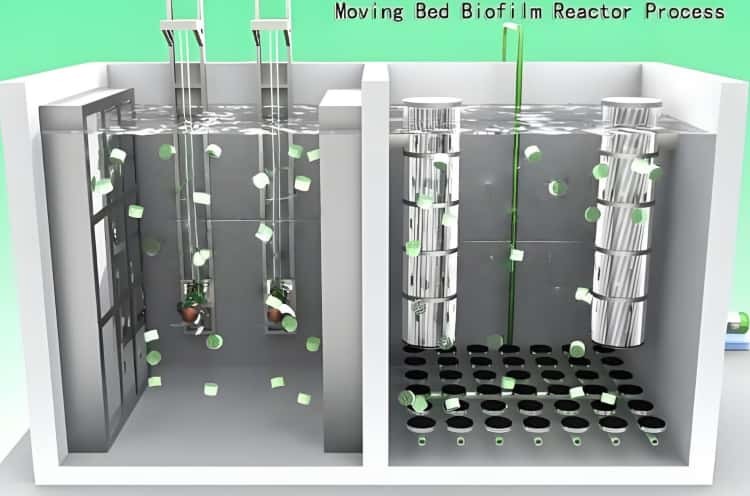
Figure 3: MBBR process diagram showing aeration-driven carrier fluidization, biofilm degradation zones, and sieve-based carrier retention at the reactor outlet.
Q7: Can MBBR Media Operate Effectively at Water Temperatures as Low as 3°C?
Short answer: Yes - field data confirms stable operation at 7–8°C; international project data validates performance at 3°C.
Low-temperature operation is a frequently cited concern for biological wastewater treatment. MBBR's biofilm-based mechanism provides a structural advantage over suspended-growth systems (activated sludge) in cold conditions:
Documented low-temperature performance:
|
Location |
Temperature |
Outcome |
|
Xinjiang Province, China |
7–8°C |
Stable, compliant effluent confirmed |
|
Nordheim WWTP, Norway (Winter Olympics facility) |
~3°C (snowmelt influent) |
Stable, compliant effluent confirmed |
Why does MBBR perform well at low temperatures? The biofilm structure retains a significantly higher biomass concentration per unit volume compared to activated sludge. Even as microbial metabolic rates slow in cold water, the high biomass density within the carrier compensates - maintaining sufficient treatment capacity to achieve discharge compliance.
Cold-Climate Design Note: For installations in regions with sustained sub-5°C conditions, increase carrier fill ratio slightly and extend hydraulic retention time (HRT) to compensate for reduced microbial activity.
Q8: Does MBBR Media Contribute to Sludge Bulking Problems?
Short answer: No - research and field data indicate MBBR media actively reduces sludge bulking risk.
Sludge bulking - caused by excessive filamentous bacteria growth - is a well-known operational challenge in activated sludge systems. International research findings on MBBR's interaction with sludge:
Filamentous bacteria disruption:
MBBR carriers physically break apart filamentous (thread-like) bacteria during fluidization, reducing their competitive advantage
Floc integrity preserved:
Normal sludge flocs (much smaller than carrier dimensions) are not disrupted by carrier movement
Improved sludge settleability:
Multiple studies report improved Sludge Volume Index (SVI) in MBBR-integrated systems vs. conventional activated sludge alone
Zero field reports of MBBR-induced bulking:
Across documented engineering applications, no cases of MBBR-associated sludge bulking have been confirmed
This makes MBBR particularly valuable as a bioaugmentation strategy in hybrid IFAS (Integrated Fixed-Film Activated Sludge) upgrades of existing activated sludge plants experiencing chronic sludge bulking.
Summary: Key Advantages of MBBR Media Systems
|
Performance Attribute |
MBBR Advantage |
|
Startup speed |
Visible biofilm: 7 days; Compliant effluent: 30 days |
|
Inoculant requirement |
Not required for municipal wastewater |
|
Maintenance |
No backwashing required |
|
Cold temperature |
Validated to 3°C (Norway field data) |
|
Sludge management |
Reduces bulking risk; improves SVI |
|
Fill ratio flexibility |
Up to 60% (aerobic), 50% (anoxic) |
|
Media modification |
Not required; standard carriers proven effective |
|
Core operation |
Self-regulating through natural biofilm sloughing |
The stable operation of any MBBR system depends on three fundamentals:
Proper fluidization conditions
1. - adequate aeration/mixing to keep all carriers in motion
Stable biofilm structure
2. - biofilm thickness naturally regulated by the sloughing cycle
Appropriate operational control parameters
3. - loading rate, HRT, DO management
When these three elements are properly designed and maintained, MBBR delivers rapid startup, cold-weather resilience, shock-load resistance, and low maintenance - making it one of the most robust biological treatment technologies available today.
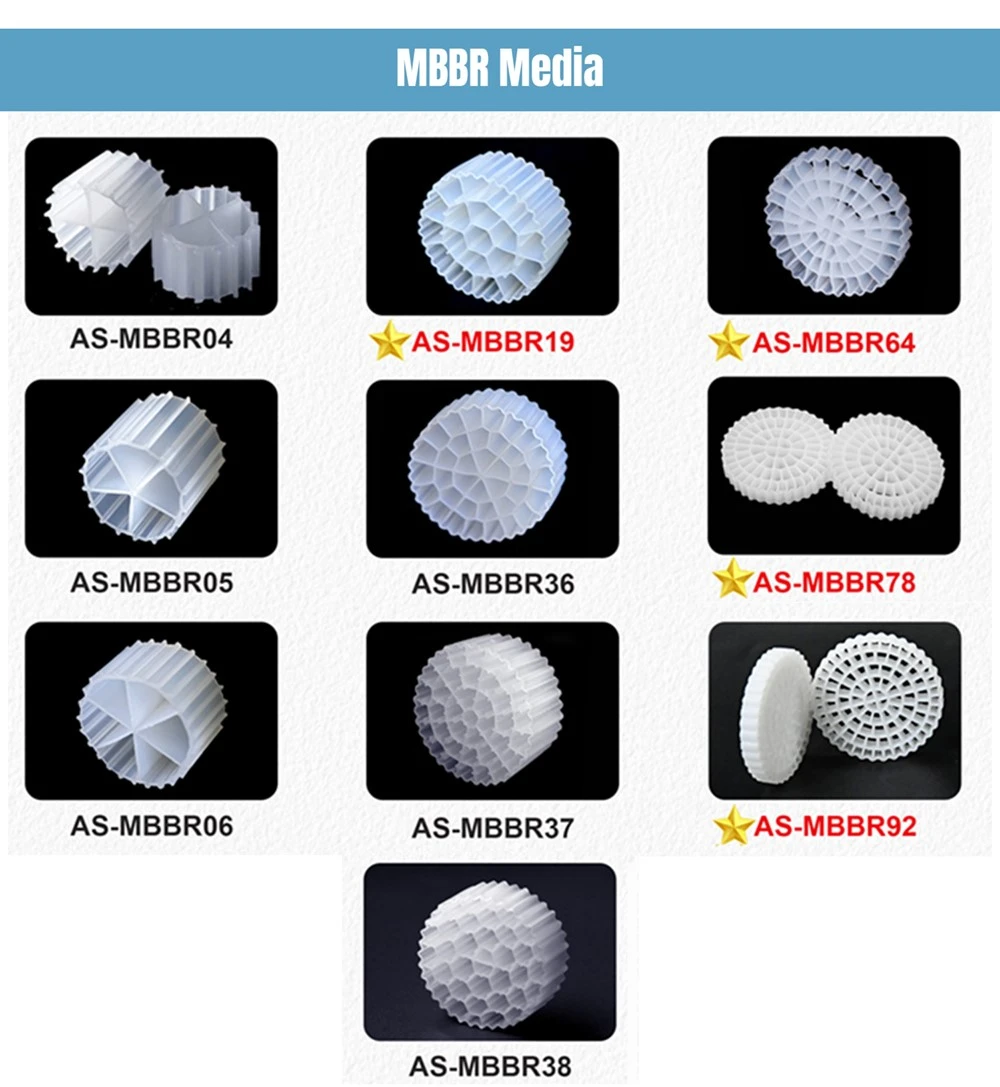
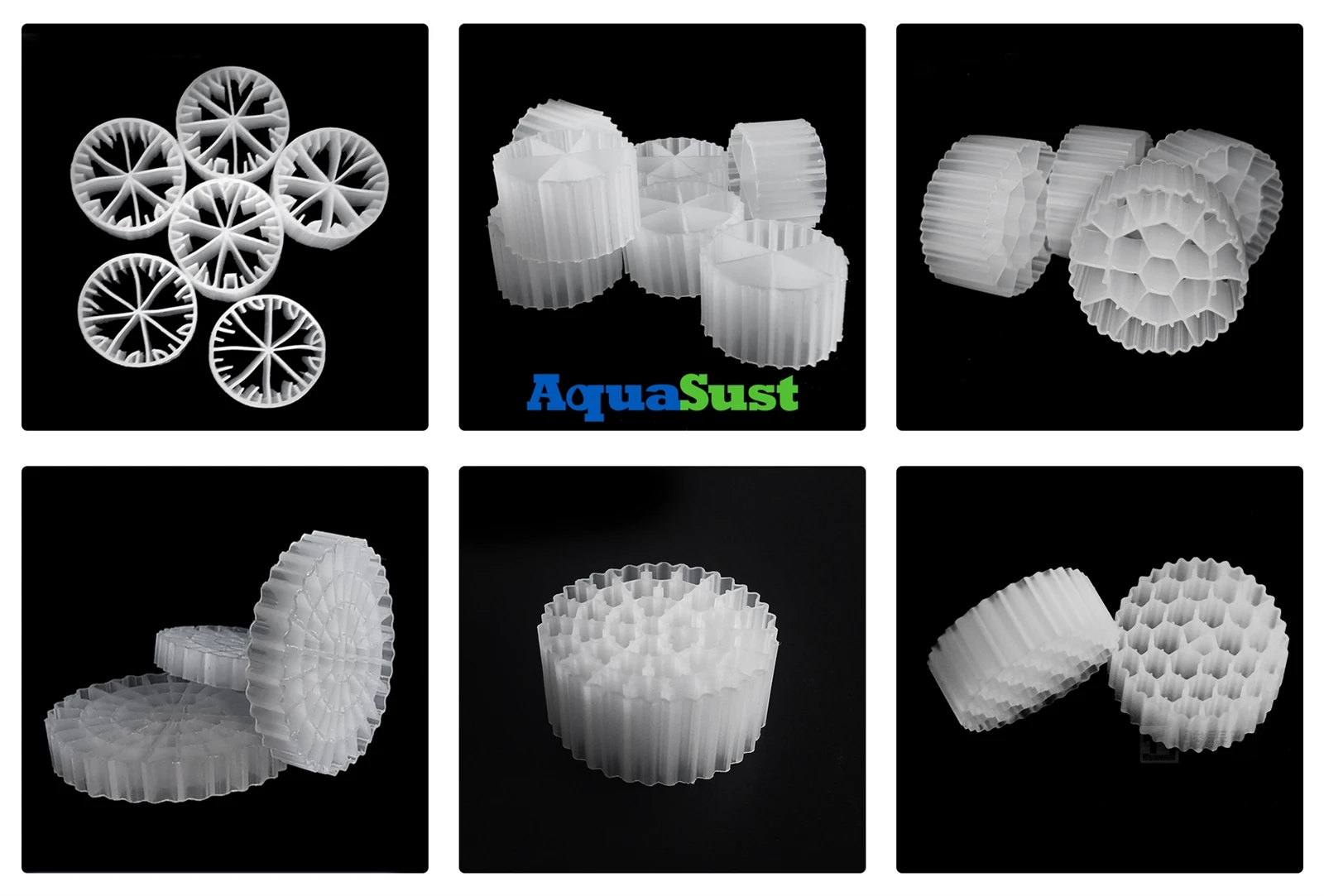
Figure 4: Aquasust MBBR media series - engineered for rapid biofilm colonization, long-term structural durability, and optimized fluidization across aerobic and anoxic zones.
Aquasust MBBR Media: Engineering-Grade Performance
At Aquasust, we apply the engineering principles discussed above to every product in our MBBR media range. Our biofilm carrier media is designed around the two core operational requirements that matter most in real projects: media quality and fluidization performance.
Key Product Features
- High specific surface area- expanded protected interior geometry maximizes available biofilm attachment area
- Rapid biofilm colonization- optimized surface texture accelerates startup; shorter commissioning timelines
- Superior fluidization behavior- carrier geometry maintains even distribution under standard aeration; no clumping
- Wear-resistant HDPE material- rated for 10–15+ years continuous operation
- Broad application compatibility- municipal wastewater, industrial effluent, aquaculture, decentralized treatment
Proven Engineering Performance
|
Feature |
Outcome |
|
Shorter startup cycle |
Faster effluent compliance |
|
Stable biofilm structure |
Consistent treatment performance |
|
Higher shock-load tolerance |
Suitable for variable-load industrial applications |
|
Low maintenance requirements |
Reduced OPEX over system lifetime |
|
Multi-application compatibility |
Municipal / industrial / aquaculture |
Ready to specify MBBR media for your next project?
Website:www.chinambbr.com
Email:Info@aquasust.com
WhatsApp:86-19357135369
Aquasust - MBBR Biofilm Carrier Media Manufacturer & Engineering Partner