








WHY Your MBBR Media Can Not Biofilm In Two Weeks
and How to Make Our Biomedia Quickly Biofilm ?
By: Cody Aquasust
Post Date: April 29th 2022
Post tags:

What is MBBR or MBBR Technology ?
MBBR is an efficient method for wastewater treatment with low sludge volume and simple operation and management. This Article mainly introduces why the Biomedia fsometimes can't Biofilm from various aspects such as the principle of MBBR system and the influencing factors of formation.
The MBBR Media is to make microorganisms attach to the surface of the MBBR carrier and form a biofilm. When the wastewater flows through the surface of the carrier, the organic matter and dissolved oxygen in the wastewater diffuse to the inside of the biofilm. The microorganisms inside the membrane carry out decomposition metabolism and organism anabolism on organic matter in the presence of oxygen, while the decomposition metabolites diffuse from the biofilm to the aqueous phase and air, thus degrading the organic matter in the wastewater.
Article Outline
● Principle of MBBR process (hanging process)
● Factors influencing MBBR biofilmed
1. MBBR Bio Carrier surface properties
2. Suspended microbial concentration
3. Activity of suspended microorganisms
● Influencing factors in the process of MBBR biofilmed
1. Forces in the process of bio-carrier film hanging
2. Effect of carrier surface hydrophilicity
3. Effect of temperature on film hanging behavior
4. Effect of MBBR carrier specific surface area and surface roughness on biofilm adhesion performance.
In the MBBR media, organic pollutants, dissolved oxygen and various essential nutrients must first diffuse from the liquid phase to the surface of the biofilm, and then into the interior of the biofilm, and only the pollutants diffused to the surface or inside the biofilm can be decomposed and transformed by the microorganisms inside the biofilm, and finally form various metabolites. In addition, in the MBBR media, the microorganisms are immobilized on the carrier, thus achieving the separation of SRT and HRT (hydraulic retention time), which enables the growth and reproduction of microorganisms with slow proliferation rate. Therefore, MBBR media is a stable and diverse microbial ecosystem.
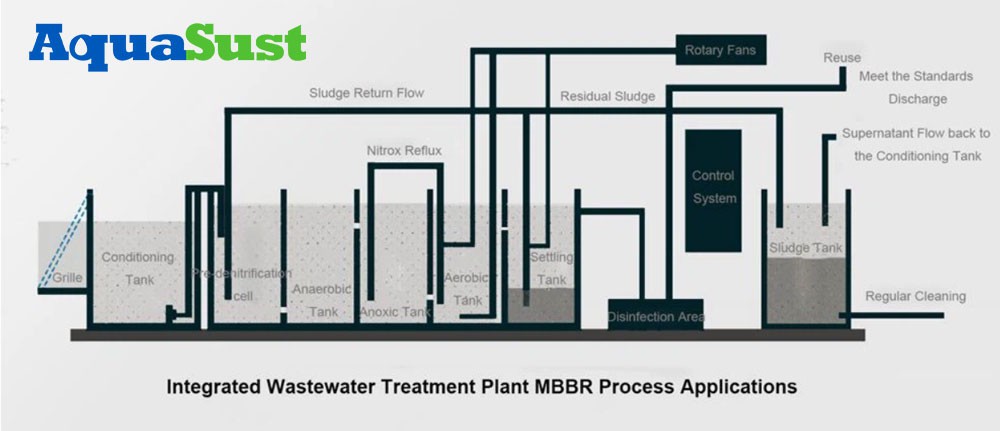
◆ Aquasust MBBR Process Flow Diagram
Principle of MBBR process (hanging Membrance process)
According to Characklis, Liu et al. the formation of microbial film usually goes through four stages: MBBR carrier surface modification, reversible attachment, irreversible attachment, and biofilm formation.
The specific description is as follows: microbial film hanging on the MBBR carrier can be divided into two stages: microbial adsorption and sequestration growth.
After the carrier is added to the water body, it first enters the adsorption period. Some of the microorganisms and filamentous materials have been attached to the surface of the carrier, and the location where more materials are attached is often the concave part of the carrier, which is not easily sheared by the water flow. At this time, the microorganisms in suspension grow in large quantities and a more obvious sludge layer appears.
After irreversible attachment, the microorganisms obtain a relatively stable growth environment on the surface of the carrier, and the microorganisms in the sludge adsorbed on the carrier soon start to grow under the condition of sufficient oxygen supply and substrate.
With the growth of culture domestication time, the biofilm growing on the surface of the carrier also grew rapidly, gradually covered the whole carrier surface and began to thicken. However, the growth of biofilm was not uniform, in the more prominent parts of the carrier, the biofilm was thinner, while the concave parts grew quite prosperous colonies, which showed that the hydrodynamic shear had an important influence on the growth of biofilm. As more and more biofilms are attached to the carriers, the apparent density of the carriers gradually decreases and becomes lighter and easier to fluidize, while the carriers in the declining zone have a slower declining rate.
MBBR Media Biofilm after 14 days in Aeration Tank
Factors influencing MBBR biofilmed
It related to the nature of the carrier surface (carrier surface hydrophilicity, surface charge, surface chemical composition and surface roughness), the nature of microorganisms (microorganism species, culture conditions, activity and concentration) and environmental factors (pH, ionic strength, hydraulic shear, temperature, nutrient conditions and contact time between microorganisms and the carrier).
1. MBBR Carrier surface properties
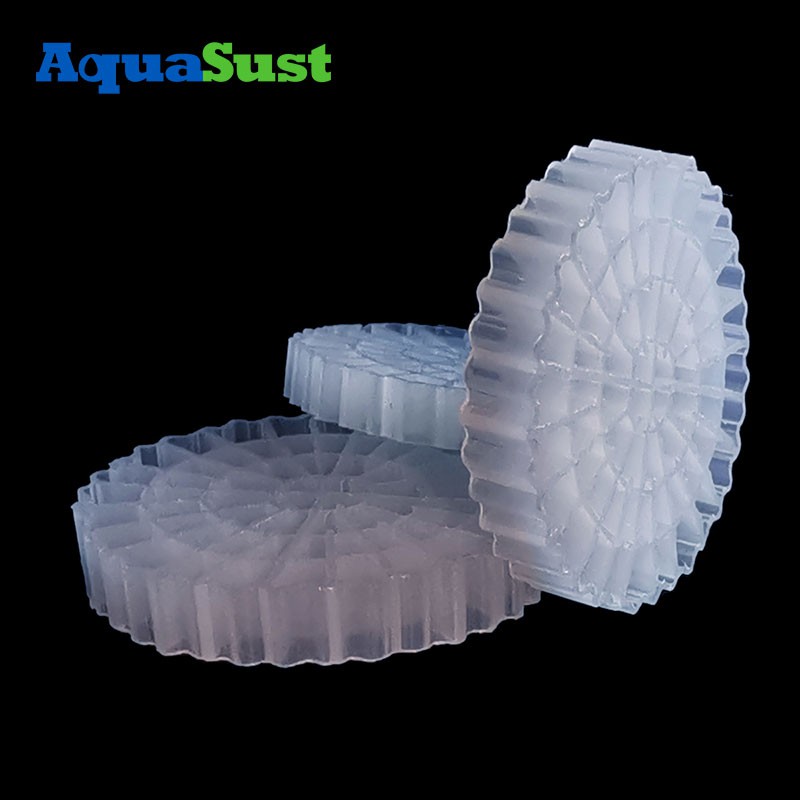
The carrier surface charge property, roughness, particle size and carrier concentration directly affect the attachment and formation of biofilm on its surface. Under normal growth environment, microorganisms have a negative charge on their surface. The roughness of the carrier surface facilitates the attachment and immobilization of bacteria on its surface.
① The surface area of the carrier increases the effective contact area between bacteria and the carrier compared to a smooth surface.
② Rough parts of the carrier surface, such as holes and cracks, act as a shield to protect the adhered bacteria from hydraulic shear forces.
It was concluded that the small particle size carriers are easier to generate biofilms because of their low mutual friction and large specific surface area compared to the large particle size carriers. In addition, the carrier concentration is also important for the MBBR biofilmed.
Wagner found that at very low carrier mass concentration, even with a biofilm thickness of 295 μm, a stable removal rate could not be achieved when treating refractory wastewater with an air-lift reactor. However, at a carrier concentration of 20-30 g/L, even if only 20% of the carriers had 75 μn thick biofilms, the reactor was still able to achieve a stable (98%) removal rate with a COD load of up to 58 kg/(m3-d).
2. Suspended Microbial Concentration
In general, as the concentration of suspended microorganisms increases, the chance of possible contact between microorganisms and the carrier increases. The results of many studies have shown that there is a critical concentration of suspended microorganisms during microbial attachment; as the microbial concentration increases, microbial transport by means of concentration gradients is enhanced.
Before the critical value, microbial transport and diffusion from the liquid phase to the carrier surface is the controlling step; once this critical value is exceeded, microbial attachment and immobilization on the carrier surface is limited by the effective surface area of the carrier and is no longer dependent on the concentration of suspended microorganisms. However, after the equilibrium of attachment and immobilization, the amount of microorganisms on the carrier surface is determined by the microorganisms and the carrier surface properties.

3. Activity of suspended microorganisms
Microbial activity is usually described by the specific growth rate (μ) of microorganisms, i.e., the rate of growth and reproduction of microorganisms per unit mass. Therefore, when studying the effect of microbial activity on the initial stages of biofilm formation, it is crucial to control the specific growth rate of suspended microorganisms.The results of the study on the formation of heterotrophic biofilms by Bryers et al. showed that the amount and initial rate of attachment and fixation of nitrifying bacteria on the surface of the carrier were proportional to the activity of suspended nitrifying bacteria.
① When the biological activity of suspended microorganisms is high, their ability to secrete extracellular polymorphs is higher.
② The energy level at which microorganisms are living is directly related to their growth rate.
③ The surface structure of microorganisms varies accordingly with their activity.
④ Microbial contact time with the carrier.
⑤ Hydraulic retention time (HRT).
⑥ Liquid phase pH.
⑦ Hydrodynamic shear force.

Influencing factors in the process of MBBR biofilmed
1. Forces in the MBBR Biofilmed process
It directly contribute to the direct interaction between the microorganisms and the surface of the carrier, and play a crucial role in the whole MBBR biofilmed process.
2. Effect of carrier surface hydrophilicity
The surface of GPUC carrier contains hydrophilic groups such as -OH and amide groups, and most microorganisms themselves have good hydrophilicity, and the carrier surface and microorganism surface can form hydrogen bonding structure; meanwhile, the free energy of hydrophilic carrier surface is lower than that of hydrophobic carrier surface, and the microorganisms in water are more likely to approach the hydrophilic carrier surface for adsorption and growth.
3. Effect of temperature on MBBR biofilmed
The suitable temperature range for aerobic microorganisms is 10~35℃. Water temperature has a greater impact on the growth of nitrifying bacteria and nitrification rate. The suitable growth temperature for most nitrifying bacteria is 25~30℃, when the temperature is lower than 25℃ or higher than 30℃ the growth of nitrifying bacteria is slowed down, below 10℃ the growth of nitrifying bacteria and nitrification is significantly slowed down.
The MBBR biofilmed test was carried out at 10℃, 20℃ and 35℃, and the amount of microorganisms attached to the filler was also measured during the whole film hanging process. The results showed that: at 10℃, the MBBR biofilmed started slowly, and it took 7d to have obvious biofilm attached, and the MBBR biofilmed matured after 21d, and the maximum amount of attached biomass was 2.1 g/L; at 35℃, the MBBR media started to biofilm after 4d, and the MBBR biofilmed matured The maximum amount of attached biofilm was 3.5 g/L after about 19 d. At about 20℃, the biofilm started to form after 2 d, and the maximum amount of attached biofilm was 5.7 g/L after about 10 d. It can be seen that the effect of temperature on the hanging film was not very obvious, and the biofilm could be formed on the surface of the filler within 15-30℃, and the hanging film started faster.
Temperature is a key factor affecting the biological activity and metabolic capacity, and its influence on the nitrification reaction process mainly lies in the growth pattern and biological activity of nitrifying bacteria.
The influence of temperature on biological activity is manifested as the influence on biochemical reaction rate and the influence on oxygen transfer rate.
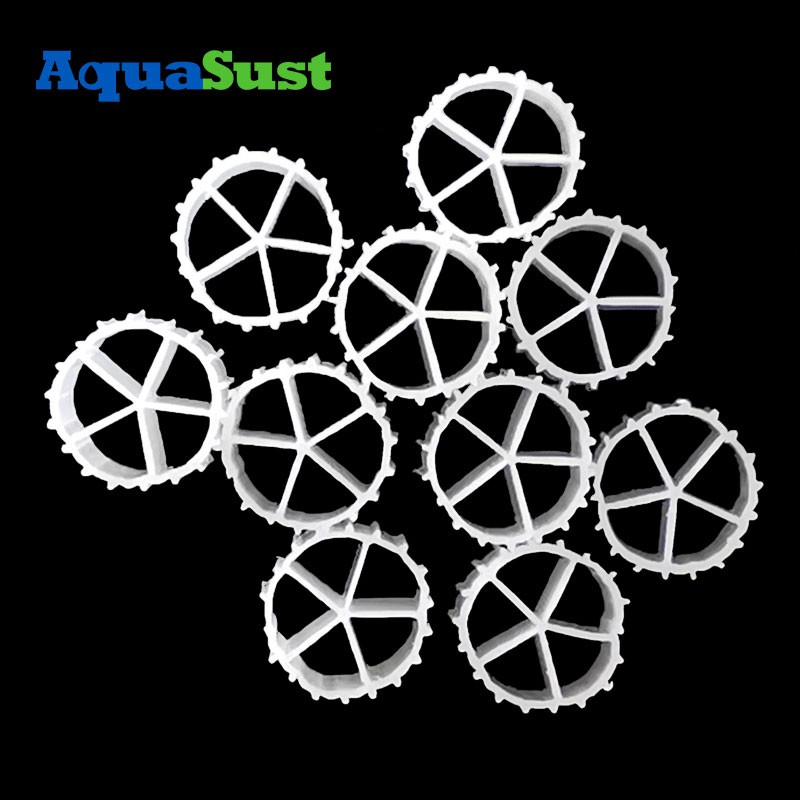
Aquasust Biofilm MBBR Carrier Media in Aeration Tank in Two Months
4. Effect of MBBR carrier specific surface area and surface roughness on biofilm adhesion performance
The large specific surface area and roughness improve the ability of the carrier to capture microorganisms. Carriers with large surface roughness have stronger redistribution ability to water flow so that the water flow in the reactor has less shear force on the biofilm on the carrier, and at the same time provides a favorable internal environment for the mixing and contact between microorganisms and substrate, which promotes the accumulation of biofilm on the packing surface. The rough surface has a thicker laminar boundary layer than the smooth surface, which can provide a good static hydrodynamic environment thus avoiding the adverse effect of water flow shear on the growth of attached microorganisms.
If you need MBBR Calculator Excel
Contact now, why not?
Whatapp or Phone:0086-15267462807
Email:Kate@aquasust.com