





Pond Bio Filter
Aquaculture is the farming of aquatic organisms such as fish, crustaceans, molluscs and aquatic plants, the worldwide demand for fish has provided the impetus to rapid growth in aquaculture. In 2012, there were 66.6 million tons of fish produced by aquaculture, which accounted for 42.2% of world food fish production. In addition, aquaculture is one of the fastest-growing food-producing sectors, with an average of 6.5 % growth in the period from 2000 to 2012.

Aquaculture systems can be classified into three main categories: extensive, semi-intensive and intensive, based on production per unit volume (m 3 ) or unit area (m 2 ). Natural small lakes fall in typical extensive systems, pond culture with feeding or aeration in semiintensive, and recirculating aquaculture systems are in intensive.
Recirculating aquaculture systems (RAS) are tank-based systems in which environmental parameters are totally controlled, so fish can be stocked at high density. RAS technology has been developed and refined for the last three decades. RAS technology has the capability to work at a high capacity with less water and are a requirement as compared with traditional fish farming, also RAS can reduce chemical and antibiotic usage and waste disposal; in addition, RAS is species-adaptable, which means fish can be produced year-round. However, RAS needs high capital and operational investment that is the main demerit. Moreover, it is a complex system for startup and expertise is needed to maintain and monitor.
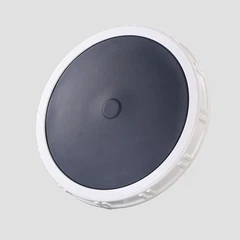
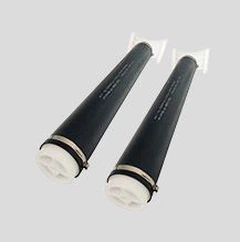
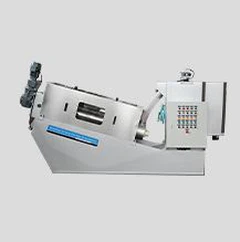
Water quality control in RAS is achieved by many different components. In general, RAS consists of a heater or heat exchanger to adjust water temperature, aeration system to reduce dissolved CO 2 concentration, oxygenation system to supply sufficient oxygen, drum filters to remove suspended solids, disinfection system (UV and ozone equipment) to inactivate pathogens and biofilter system to remove nitrogen waste. Alkalinity in the system is controlled by adding chemicals into it.
There are many types of biofilm systems used for water treatment, such as trickling biofilters, rotating biological contactors (RBC), granular media biofilters, floating bead biofilters and fluidized bed biofilters, all have advantages and disadvantages. The trickling filter is not volume-effective; mechanical failures have often been experienced in rotating biological contactors; granular media biofilters need periodic back flashing and the fluidized bed reactors show hydraulic instability. In this context, the moving bed biofilm reactor (MBBR) technology was developed in the late 1980s and early 1990s in Norway.

Now MBBR has been applied world-widely for the treatment of municipal and industrial wastewaters, as well as for water treatment in aquaculture. In the aquaculture industry, MBBR is mainly applied for nitrification, as well as the removal of organic matters. In order to avoid the heterotrophic bacteria that consume organic matter suppressing the nitrifying bacteria at high organic loads, MBBR is always operated at low organic loads inan aquaculture system.
Compared with most other biofilm reactors, MBBR utilizes the whole tank volume for biomass growth, it also has an insignificant head-loss and no need for periodic backwashing and is not susceptible to clogging. In addition, the filling fraction of biofilm carriers in the reactor can be subject to preferences. However, it is recommended that filling fractions should be less than 70 % to keep the carrier suspended freely in the reactor.
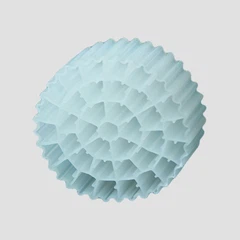
MBBR is a technology based on biofilm theory, with an active biofilm growing on specially designed plastic carriers (or biomedia) that are suspended in the reactor. It can be operated both in aerobic and anaerobic conditions,the biomedia are kept suspended by agitation from aeration diffusers, while in anaerobic cases, a mixer is used to keep the biomedia moving. Bio-medias are made from different materials and high-density polyethylene is commonly used, which has a density about 0.95g/cm 3. In order to provide a maximum specific surface area (m 2 /m 3 ), bio-medias are designed in various shapes and sizes.