







By: Kate
Email:kate@aquasust.com
Date: April 9, 2025


MBBR (Moving Bed Biofilm Reactor) is a technology used for wastewater treatment. It employs floating plastic media to provide a growth surface for biofilm within the reactor. By increasing the contact area and activity of microorganisms, it enhances the degradation efficiency of organic matter in wastewater, making it suitable for treating high-concentration organic wastewater.
01 Main Working Principle

Based on biofilm technology, microorganisms attach to floating plastic media. This technology utilizes the natural degradation ability of microorganisms to remove organic substances from wastewater.
Reactor Structure
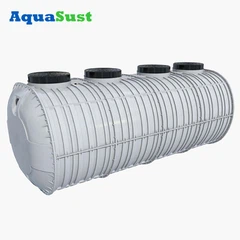
The MBBR system consists of a reactor (typically a cylindrical or rectangular tank) and a set of floating plastic media. These plastic media are usually lightweight materials with a high specific surface area, allowing them to float freely in water.
Role of Plastic Media
These plastic media move freely within the reactor, providing a large surface area for microbial attachment. The high specific surface area and specialized design of the media enable more microorganisms to adhere, forming a biofilm.
Formation and Function of Biofilm
Microorganisms grow on the surface of the plastic media to form a biofilm. This film consists of bacteria, fungi, and other microorganisms that effectively degrade organic matter in the wastewater. The thickness and activity of the biofilm determine the efficiency of wastewater treatment.

02 Working Process
By optimizing microbial growth conditions, MBBR improves the efficiency of wastewater treatment, making it an important technological approach in modern wastewater treatment engineering.
Wastewater Treatment Process
Influent Stage – Untreated wastewater is introduced into the reactor.
Reaction Stage – Inside the reactor, the wastewater is thoroughly mixed with the floating plastic media, and organic matter in the wastewater is degraded by the microorganisms in the biofilm.
Sludge Removal – After treatment, the wastewater flows out of the reactor, while some microorganisms and sludge are also discharged. Part of the biofilm is removed to maintain normal system operation.
Effluent Stage – The treated wastewater undergoes further post-treatment processes such as sedimentation or filtration before being discharged into the environment or subjected to additional treatment.

Advantages of MBBR
High Treatment Efficiency – Due to the large surface area of the plastic media for microbial growth, MBBR systems can effectively treat high-concentration organic wastewater.
Strong Adaptability – MBBR systems can handle various types of wastewater, including domestic sewage and industrial effluent.
Small Footprint – Compared to traditional activated sludge methods, MBBR systems require less space due to their high treatment efficiency.
Easy Operation – MBBR systems are simple to operate and maintain, with stable performance.