





In Moving Bed Biofilm Reactor (MBBR) engineering design and biochemical efficiency assessment, specific surface area is frequently prioritized by procurement managers and process engineers as the primary evaluation parameter. However, a widespread operational discrepancy in global wastewater treatment facilities is that media with a nominal geometric surface area exceeding 1,200 m²/m³ often delivers significantly lower organic and ammonia removal rates than media with a nominal 800 m²/m³. The root cause lies in failing to distinguish between nominal geometric area and protected effective surface area (SSAprot) under hydrodynamic shear stress and biofilm attachment kinetics.
As international wastewater effluent standards become increasingly stringent and total lifecycle operational expenditures (OPEX) require precise control, wastewater engineering must transition from coarse nominal area claims to rigorous hydrodynamic simulation, boundary layer mass transfer calculations, and validated biofilm kinetics. This technical guide explores the physical mechanisms governing effective surface area, details metrology via industrial 3D optical scanning, and establishes mathematical kinetics models for optimizing biological wastewater treatment.
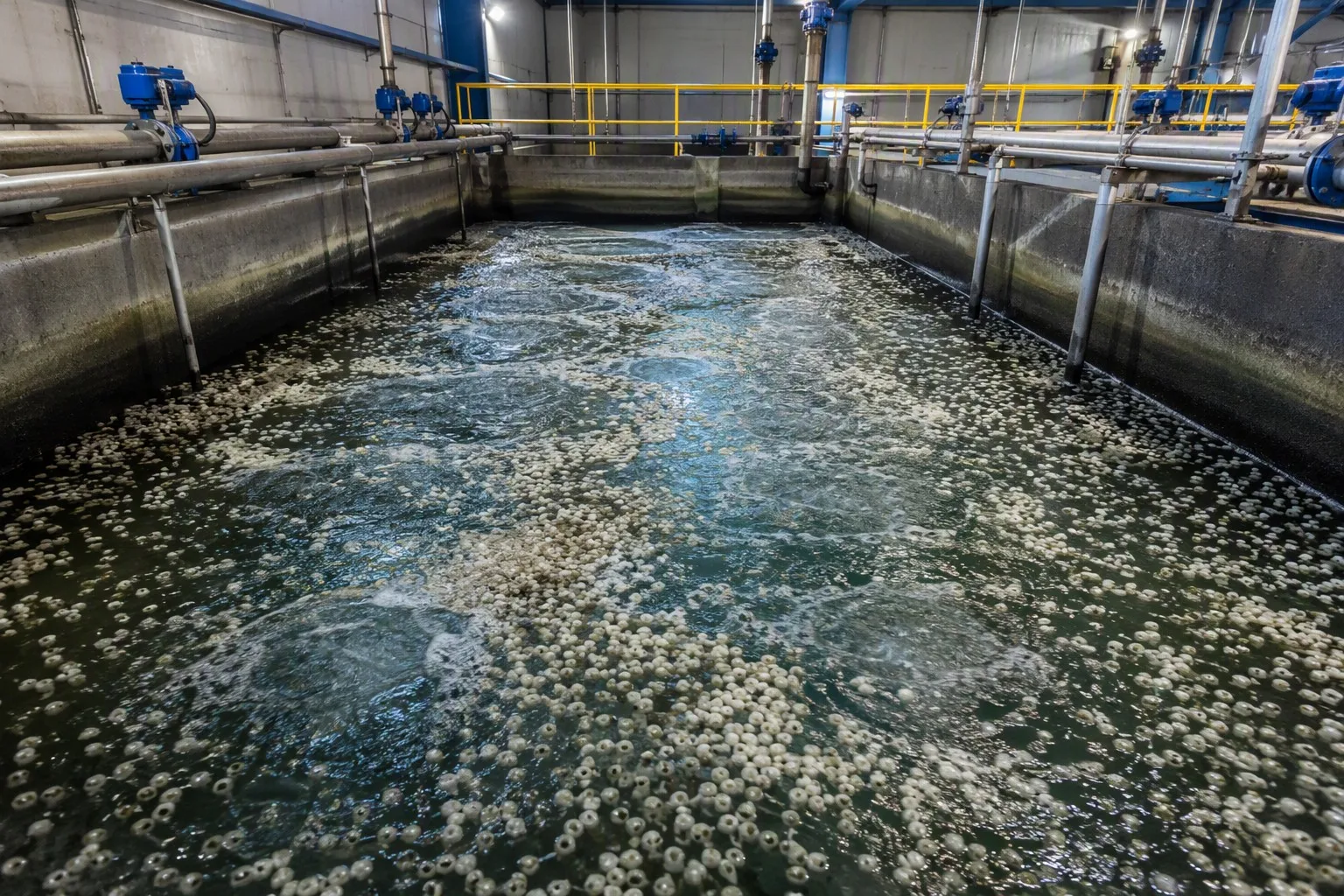
Figure 1: Full-scale three-dimensional fluidization and uniform suspension of Aquasust high-activity MBBR biofilm carriers in an aerobic biological treatment basin.
1. Nominal Geometric Area vs. Protected Effective Surface Area
MBBR biofilm carriers remain in continuous, random three-dimensional motion driven by aeration bubbles and hydraulic recirculation. Understanding true functional surface area requires differentiating between two distinct physical zones:
1.1 Carrier Collision and Hydrodynamic Shear Zone
The exterior perimeter of the carrier experiences continuous mechanical collisions with adjacent carriers, concrete reactor basin walls, and retention screens. Intense contact friction combined with high hydrodynamic shear stress prevents biomass from establishing mature, intact, and biologically resilient biofilm layers on outer surfaces.
1.2 Protected Internal Cavities and Mass Transfer
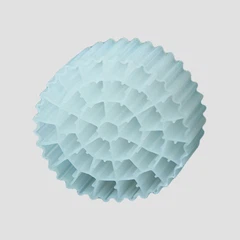
The internal voids structured by radial supporting ribs, inner concentric rings, and micro-grooves effectively shield microbial colonies from excessive external abrasion and fluid shear. This sheltered micro-environment allows slow-growing autotrophic microorganisms-such as Ammonia-Oxidizing Bacteria (AOB) and Nitrite-Oxidizing Bacteria (NOB)-to cultivate stable biofilms. The internal cavity surface area that maintains long-term biological activity without mechanical stripping constitutes the Protected Specific Surface Area (SSAprot).
Engineering reality dictates that the Surface Area Loading Rate (SALR) is governed strictly by SSAprot:
SSAprot = (Ainternal × Nunit) / Vtotal
Where Ainternal represents the protected internal surface area per unit, Nunit is the carrier count per cubic meter, and Vtotal is effective reactor volume.
2. High-Precision 3D Laser Metrology and Surface Micro-Morphology
Traditional surface area estimation relying on 2D geometric unwrapping or liquid displacement often exhibits measurement uncertainties of 15%–25%. Modern quality verification integrates industrial optical metrology:
2.1 Blue-Light 3D Laser Scanning and Digital Surface Reconstruction
Using metrology-grade blue-light 3D scanners with volumetric precision within ±0.005 mm, complete 360-degree point clouds of single injection-molded carriers are acquired. Advanced reverse engineering software isolates external friction perimeters and extracts the true net surface area of sheltered internal ribs.
2.2 Virgin High-Density Polyethylene (HDPE) Micro-Roughness Control
Substrate composition directly governs initial microbial colonization. Aquasust exclusively utilizes 100% Virgin High-Density Polyethylene (virgin HDPE, raw polymer density 0.960–0.980 g/cm³). Through electrical discharge machining (EDM) texturing of injection mold cavities, internal carrier surfaces achieve controlled micro-roughness (Ra = 1.6 – 3.2 μm). This micro-scale profile minimizes contact angles, accelerating the adhesion of extracellular polymeric substances (EPS) and hydrophilic proteins during the startup phase.

Figure 2: Microscopic profile of Aquasust 100% virgin HDPE MBBR media featuring optimized geometric fins and high stress-crack resistance.
3. Biofilm Attachment Kinetics Mathematical Modeling
Biofilm development is non-linear, governed by steady-state diffusion-reaction kinetics across liquid-solid boundary layers:
rs = [ (kmax × Sb) / (Ks + Sb) ] × η × Xf × Lf
Where:
- rs: Substrate removal rate per unit surface area (g/(m²·d));
- Sb: Bulk liquid phase substrate concentration (mg/L);
- Ks: Half-saturation constant;
- η: Internal mass transfer effectiveness factor within the biofilm matrix;
- Xf: Active microbial biomass density within the biofilm;
- Lf: Active biofilm thickness (optimal range: 50 – 150 μm).
3.1 Key Environmental Variables Influencing Startup Colonization
- Hydraulic Shear and Aeration Turbulence: Excessive aeration strips nascent bio-layers; inadequate aeration causes carrier agglomeration. Target micro-eddy Reynolds numbers between Re = 1,500 – 3,000;
- Temperature Effects (Arrhenius Kinetics): At water temperatures between 20°C – 25°C, complete biofilm maturation occurs within 12 – 18 days. In cold climates (8°C – 10°C), nitrifier growth slows, extending acclimation to 30 – 45 days;
- Nutrient Proportions (C:N:P): Balanced macronutrients and trace mineral availability enhance EPS secretion by more than 30%.
4. MBBR Carrier Specifications and Protected Area Matrix
| Carrier Model | Dimensions (mm) | Protected SSA (m²/m³) | Polymer Density (g/cm³) | Filling Rate Range | Biofilm Thickness (μm) | Typical Application |
|---|---|---|---|---|---|---|
| AS-MBBR-19 | ∅25 × 10 | 650 – 720 | 0.965 – 0.975 | 30% – 55% | 80 – 120 | High-load municipal COD removal and conventional nitrification |
| AS-MBBR-37 | ∅25 × 12 | 800 – 900 | 0.965 – 0.980 | 40% – 60% | 60 – 100 | Municipal upgrading, advanced biological nitrogen and phosphorus removal |
| AS-MBBR-64 | ∅25 × 4 | 1,050 – 1,200 | 0.970 – 0.985 | 35% – 50% | 40 – 70 | Footprint-constrained underground WWTPs, dedicated nitrification |
| AS-MBBR-S | ∅25 × 10 | 600 – 680 | 0.960 – 0.970 | 25% – 45% | 100 – 150 | High-salinity industrial, pharmaceutical, and refractory chemical wastewater |
5. Engineering Compliance across Global Climates (EU & North America)
5.1 European Winter Conditions and REACH Regulation (EU)
In Central and Northern Europe where winter biological basin temperatures dip to 6°C – 10°C, specific surface area safety margins must be increased by 20%–30%. Carriers must utilize 100% virgin HDPE possessing cryogenic impact ductility (brittleness temperature ≤ -60°C). Full compliance with EU REACH (EC 1907/2006) SVHC restricted substance thresholds (< 0.1% w/w) prevents plasticizer leaching into natural receiving waters.
5.2 North American Municipal Upgrading and EPA Standards
For municipal facilities operating under stringent National Pollutant Discharge Elimination System (NPDES) permits requiring total nitrogen (TN ≤ 3 mg/L), carriers with a minimum protected surface area of 850 m²/m³ are recommended. Staged pre-denitrification MBBR coupled with post-nitrification aerobic loops under dissolved oxygen (DO 1.5 – 2.0 mg/L) ensures sustained nitrification rates of 0.8 – 1.2 g NH₄⁺-N/(m²·d).
6. Frequently Asked Questions (FAQ)
Q1: Why do some ultra-high nominal surface area carriers (>1,200 m²/m³) fail in real wastewater applications?
A: When internal channels are excessively narrow, inadequate hydraulic shear or elevated influent suspended solids (SS) result in severe biofilm clogging. Once voids become packed with senescent sludge, dissolved oxygen and nutrients cannot penetrate the interior. The micro-environment turns anaerobic and acidic, slashing effective biological surface area by over 70% and compromising effluent quality.
Q2: How can plant operators rapidly assess biofilm health on-site?
A: Sample 20–30 fluidized carriers and gently rinse superficial flocs with deionized water. Healthy autotrophic nitrifying biofilm appears as a light brownish or golden-tan thin layer adhering firmly to internal fins. Conduct a 2-hour Specific Oxygen Uptake Rate (SOUR) test in an aerated beaker with ambient ammonia; an oxygen uptake rate ≥ 15 mg O₂/(g MLSS·h) confirms robust biological activity.
Selecting certified virgin HDPE media with independently verified protected surface area is essential for reliable, high-load MBBR operations. Contact Aquasust engineering specialists for custom media sizing and kinetic design calculations for municipal and industrial wastewater facilities.