





The past and present of MABR-Subvert your perception of aeration with 60 years
Since last year, there have been more people discussing MABR technology in the sewage treatment industry. I think Malaysian customers have always strongly recommended us to start selling MABR, and told me that MABR technology has great prospects, which is the future MBBR technology, so with this article, we can do some understanding of MABR in advance.
At the beginning, the MABR technology was not yet developed. Some people in the industry listened to Fluence's introduction of the MABR process at IFAT in Munich. At that time, Fluence was also called Emefcy (homonymous M-F-C, indicating that this company has something to do with microbial fuel cells). At that time, I felt that the technology was very powerful, but because of commercial reasons, I didn't have the opportunity to introduce the technology. Now that the conditions permit, I would like to introduce the MABR process in two phases. Today I will first talk about the past and present of MABR.
1. What is MABR?
MABR, the full name of Membrane Aeration Bioreactor, is membrane aeration bioreactor. As the name implies, it is a biological process that uses membranes for aeration, but don't get me wrong. The so-called membrane aeration does not refer to microporous aeration; MABR is an upgraded version of the traditional activated sludge process-it can be based on the existing tank capacity. On the other hand, more sewage can be treated with less oxygen transfer energy consumption.
How does it do it?
A salesperson who sells the MABR process may tell you: "We have a self-developed breathable membrane that transmits oxygen to the biofilm adhered to the breathable membrane. Like the human lung, this is a breathable membrane."
Didn't understand sales? Let's review its development history first.
2. The budding period of MABR
The research of MABR process can be traced back to the 1960s. The famous F. J. Ludzack and Morris Ettinger used breathable plastic film for oxidation in 1960. They could already see the growth of biofilm on the plastic film.

For some reason, research in this area was silent for nearly 30 years. Until 1978, related research was reproduced-the team of Professor Charles Jenkins of West Virginia University published an article entitled "Pure oxygen fixed film reactor" in the Journal of the Environmental Engineering Division. They used Teflon capillary tubes to make breathable membranes and synthetic sewage for experiments, and the effect seemed to be good-even under high organic load conditions, the removal rate of BOD was as high as 90%. But they called the designed reactor MABR, but Aerobic Media Trickling Filter. I personally guess that this is because the biological trickling filter is more familiar, after all, it was one of the most common sewage treatment processes in the first half of the last century.
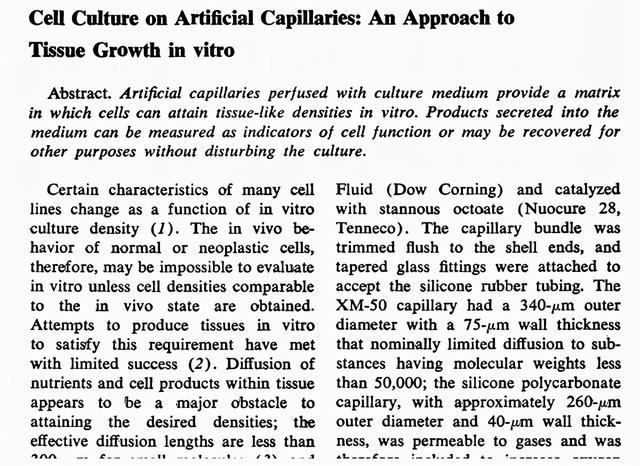
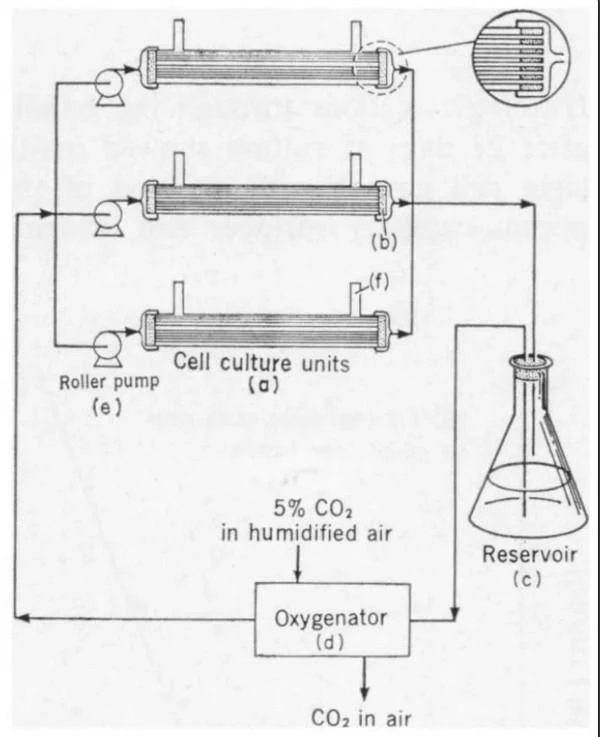
Why did they think of experimenting with Teflon capillaries? It is said to be inspired by an article in "Science" in 1972-American medical people use artificial capillaries to do cell culture in vitro. I turned over the original text, the principle is indeed very similar. Does this mean that many innovations in the sewage industry need to hold the thighs of the biology and chemistry industry?
3. The road to pilot test
But after that, the MABR research seemed to be dropped again. It wasn't until 1986 that Canadian Dr. Pierre Cté and several other colleagues published the following article in the Journal of Membrane Science, that the MABR research was back on track.

The beginning of the paper published by Dr. Pierre Cté and his colleagues in 1986 | Source: jstor
The following is a schematic diagram of the hollow fiber membrane module he drew (it was not easy to draw a picture that year): Because oxygen was transferred from one side of the membrane to the other side of the membrane through diffusion, no bubbles were generated, so they were Call it bubble-free aeration.
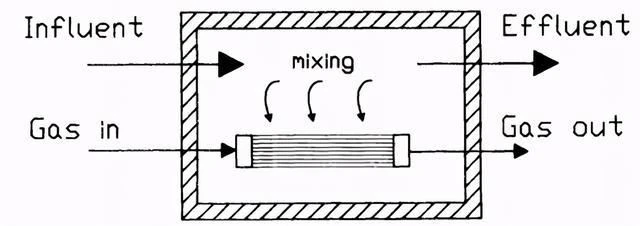
Schematic diagram of oxygen transfer in hollow fiber membrane drawn by Dr. Cté | Source: JSTOR
But later, the Canadian went to work on more important things-he went to a great company to develop ultrafiltration membranes. This company is called ZENON Enviroment. He became the company's CTO in 1998 until it was later acquired by GE.

Fortunately, Dr. Cté was not the only one who was tinkering with this stuff at the time, and Professor Michael Semmens of the University of Minnesota was also doing related research. In 1999, his team published an article titled "Pilot-Plant Treatment of a High-Strength Brewery Wastewater Using a Membrane-Aeration Bioreactor" in the journal Water Environment Research. The term MABR is officially launched and entering the pilot test stage.
Fortunately, Dr. Cté was not the only one who was tinkering with this stuff at the time, and Professor Michael Semmens of the University of Minnesota was also doing related research. In 1999, his team published an article titled "Pilot-Plant Treatment of a High-Strength Brewery Wastewater Using a Membrane-Aeration Bioreactor" in the journal Water Environment Research. The term MABR is officially launched and entering the pilot test stage.
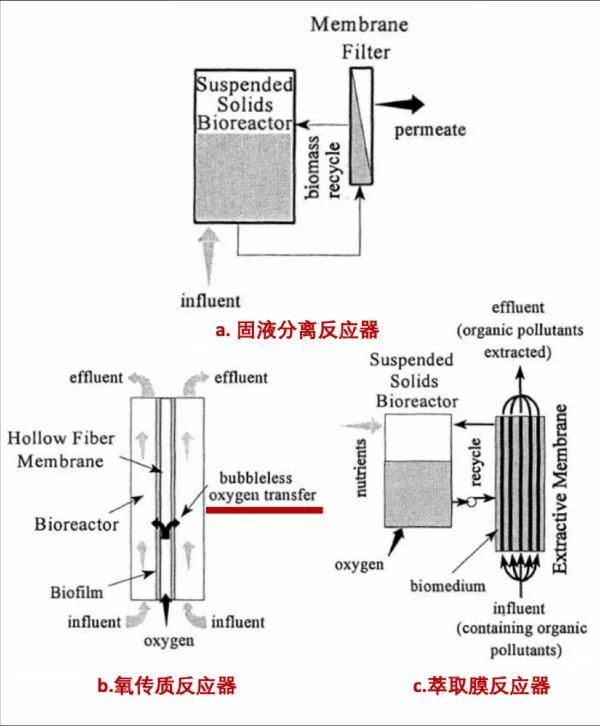
A review of membrane reactors written by the Semmens team | Adapted by a farmer in Wa Village, reference: JSTOR
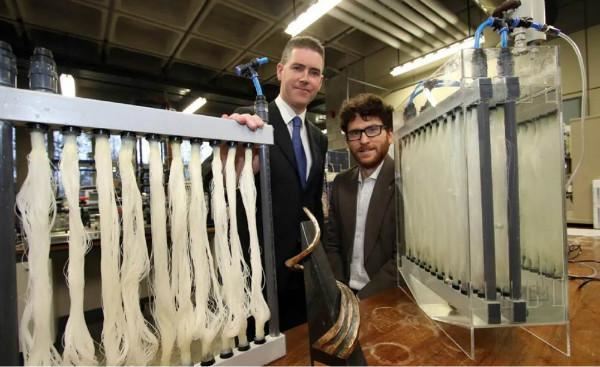
In the same year, Professor Eoin Casey's team from the University of Dublin in Ireland also reported on the research progress of membrane oxygen transfer materials in the international journal Biotechnology and Bioengineering, and also used the abbreviation MABR. The only difference is that A here refers to aerated, and Not aeration. Please understand the difference.