






Overview Of Dewatering Screw Press
What Is A Dewatering Screw Press ?
A dewatering screw press is a machine that is used to remove excess water from wet, moist, or sludge-like materials. It is designed to separate liquids from solids by applying pressure to the material and forcing the liquids out, leaving behind a drier, more compact material.
The dewatering screw press works on the principle of pressure filtration. The wet material is fed into the press, and a slowly rotating screw forces the material along the length of the press. As the material moves, the screw compresses and squeezes it, expelling the excess water through small holes in the press. The water is collected for disposal or further treatment, while the solids remain in the press and continue to be compressed until they reach the desired level of dryness.
The screw press operates continuously, so the material is constantly fed into one end of the press, and the dry material is discharged from the other end. The speed of the screw and the pressure applied to the material can be adjusted to control the level of dewatering, allowing the operator to achieve the desired moisture content of the material.
The dewatering screw press is highly efficient and can handle large volumes of wet material, making it an ideal solution for many industrial applications where wet materials need to be dried or the liquids need to be separated from the solids.
The Structure Of Dewatering Screw Press
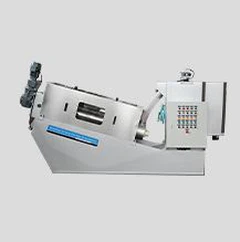
The structure of a typical dewatering screw press consists of several main components:
Inlet: The inlet is the point of entry for the material to be dewatered. It is typically located at the top of the press and can be a hopper or a pipe depending on the application.
Screw: The screw is the central component of the press, consisting of a long, rotating shaft with a helical blade or series of blades along its length. As the screw rotates, it conveys the material along the length of the press while also applying pressure to squeeze out the liquid.
Screen: A screen or perforated plate is located along the length of the screw and is used to trap the solid material while allowing the liquid to pass through. The screen or plate is typically made of stainless steel, and the size and spacing of the perforations can be adjusted to optimize dewatering performance.
Outlet: The outlet is the point of exit for the dewatered material, typically located at the end of the press. The dewatered material may be discharged into a container, conveyor, or other equipment.
Drive unit: The drive unit is typically located at one end of the press and is responsible for rotating the screw. The drive unit may be an electric motor, hydraulic motor, or other type of power source.
Control system: The control system includes various sensors, monitors, and controllers to regulate the flow of material, pressure, and other operating parameters. It may also include a programmable logic controller (PLC) or other computerized control system for automated operation.
The specific design and configuration of a dewatering screw press may vary depending on the application, such as the type of material being processed, the required dewatering performance, and other factors. However, these basic components are typically found in most dewatering screw presses.
The Working Principle Of Dewatering Screw Press
The working principle of a dewatering screw press is similar to that of a standard screw press, but it is specifically designed to separate liquids from solids in a slurry or wastewater. The dewatering screw press is made up of a rotating screw that moves through a stationary screen or filter, which allows the liquid to be separated from the solid material.
The slurry or wastewater to be processed is fed into the inlet of the screw press, where it is conveyed by the screw to the discharge end of the press. As the material is compressed by the screw, the liquid is forced out through the screen or filter, while the solid material remains inside the press.
The key difference between a standard screw press and a dewatering screw press is the addition of a backpressure cone. The backpressure cone provides resistance to the movement of the material through the press, which creates a buildup of pressure that squeezes the liquid out of the slurry or wastewater. The pressure gradually increases as the screw moves along the screen or filter, resulting in a dry cake of solid material and a clear liquid.
The Development Of Dewatering Screw Press
Dewatering screw presses have been around for many years and have undergone several improvements and innovations over time. Here are some of the developments that have led to the modern dewatering screw press:
Improved screw design: The screw design has been improved to allow for better dewatering of materials and increased throughput. The screw design is critical to the effectiveness of the dewatering process.
Material selection: The materials used in the construction of screw presses have also improved, leading to greater durability and efficiency. Stainless steel is commonly used in modern screw presses due to its corrosion resistance and durability.
Automation and control: Modern dewatering screw presses are often equipped with advanced automation and control systems that allow for efficient operation and control of the dewatering process.
Optimization of energy consumption: With the development of more efficient motors and the optimization of the screw design, modern dewatering screw presses are now much more energy-efficient than their predecessors.
Improved separation and drying: Advances in technology have led to improved separation and drying of materials, which has resulted in more efficient dewatering.
In conclusion, the development of dewatering screw presses has led to more efficient and effective dewatering of materials, resulting in reduced waste and improved product quality. The ongoing development of this technology is expected to continue, with the goal of further improving efficiency and reducing environmental impact.
Application Of Dewatering Screw Press
Some specific applications of a dewatering screw press include:
Sludge dewatering: Dewatering screw presses are widely used in municipal wastewater treatment plants for sludge dewatering. The device can effectively separate solid particles from the liquid component, reducing the volume and weight of the sludge, and making it easier and more cost-effective to transport and dispose of.
Food processing: In the food industry, a dewatering screw press can be used to separate the liquid component from food waste and by-products, such as fruit and vegetable peelings. This process can help reduce waste and improve the efficiency of food production.
Pulp and paper processing: Dewatering screw presses can be used in the pulp and paper industry for the dewatering of pulp and paper sludge, as well as for the separation of wood chips and other materials used in the paper manufacturing process.
Chemical processing: Dewatering screw presses are used in the chemical industry for the separation of solids and liquids in various chemical processes.
Overall, the dewatering screw press is a versatile and efficient device that can be used in many different applications where there is a need to separate liquid from solid particles.