







By: Kate
Email:kate@aquasust.com
Date: 2nd December 2024

Principle and Characteristics of the Lamella Settling Tank
According to the principle of shallow tanks, under the condition of a fixed effective volume of the settling tank, the larger the area of the settling tank, the higher the sedimentation efficiency. This is independent of the sedimentation time. The shallower the settling tank, the shorter the sedimentation time. The sedimentation zone of an Lamella packing settling tank is divided into thin layers by a series of parallel Tube settlerss or Lamellas, reflecting the principle of shallow tanks.


Characteristics of Tube settlers and Lamella Sedimentation tank:
1.Utilization of Laminar Flow Principle
The water flows between the plates or inside the tubes, and the hydraulic radius is very small, resulting in a low Reynolds number. Typically, the Reynolds number (Re) is around 200, and the flow exhibits laminar characteristics, which is highly beneficial for sedimentation. The Froude number of the water flow inside the Lamellas is approximately between 110^-3 and 110^-4, indicating a stable flow state.
2.Increased Settling Tank Area
The design increases the area of the settling tank, improving the sedimentation efficiency. However, due to factors such as the specific arrangement of the Tube settlerss, the influence of inlet and outlet water, and the flow pattern inside the plates or tubes, the actual treatment capacity cannot achieve the theoretical multiple. The actual increase in sedimentation efficiency compared to the theoretical sedimentation efficiency is known as the effective coefficient.
3.Shortened Settling Distance
The particles have a shorter settling distance, significantly reducing the sedimentation time.
4.Re-coagulation of Flocculent Particles
The re-coagulation of flocculent particles inside the Tube settlerss or tubes promotes further particle growth, enhancing sedimentation efficiency.
Structure of Lamella Sedimentation tank
The structure of an Lamella or Tube settlers settling tank is similar to that of a general settling tank. It consists of four main parts: the inlet, sedimentation zone, outlet, and sludge collection zone. The key difference is that in the sedimentation zone, a number of Lamellas or Tube settlerss are installed.
In Tube settlers or Lamella Sedimentation tank, the water flow direction across the Tube settlerss can be classified into three types: upward flow, downward flow, and horizontal flow, as shown in Figure 2.
· Upward Flow (also called countercurrent flow): The water flows upward through the Lamellas or plates, while the settled solids flow downward. Their directions are exactly opposite.
· Downward Flow (also called co-current flow): The water flows downward through the Lamellas or plates, and the settled solids also flow downward in the same direction.
· Horizontal Flow (also called transverse flow, applicable only to Tube settlerss): The water flows horizontally across the plates.
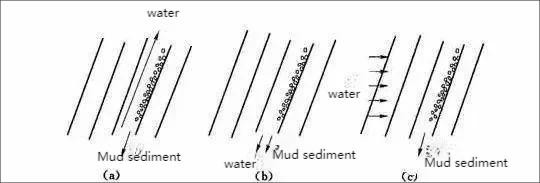
When the flow direction is the same, it is called downward flow (also known as co-current flow). When the water flows in a horizontal direction, it is called horizontal flow (also known as transverse flow, applicable only to Tube settlerss).
· Inlet Area
The water flows into the settling tank from a horizontal direction. The inlet area mainly includes perforated walls, slot walls, and downward flow Lamella inlets, etc., to ensure uniform water distribution across the width of the tank. The design and layout requirements are similar to those of a horizontal flow settling tank. To ensure uniform water flow in the upward flow Lamellas, a certain height of the distribution area must be maintained below the Lamellas, and the water flow velocity at the inlet section should not exceed 0.02-0.05 m/s.
· Inclination Angle of Tube settlerss and Tubes
The angle between the Tube settlers and the horizontal direction is called the inclination angle. The smaller the inclination angle (α), the smaller the retention velocity (u0), and the better the settling effect. However, to ensure that the sludge can automatically slide down and the sludge discharge is smooth, the α value should not be too small. For upward flow Tube settlers or tube Sedimentation tank, α is generally not less than 55°-60°. For downward flow Tube settlers or tube Sedimentation tank, where sludge discharge is easier, α is generally not less than 30°-40°.
· Shape and Material of Tube settlerss and Tubes
To make full use of the limited volume of the settling tank, Tube settlerss and tubes are designed with densely packed geometric cross-sections, such as square, rectangular, regular hexagonal, and corrugated shapes. For easy installation, several or hundreds of Lamellas are often assembled together as a module, and then multiple modules are placed in the sedimentation area. The materials used for Tube settlerss and tubes should be lightweight, durable, non-toxic, and cost-effective. Common materials include paper honeycomb structures and thin plastic sheets. Honeycomb Lamellas can be made from impregnated paper and cured with phenolic resin, usually formed into regular hexagons with an inscribed circle diameter of 25mm. Plastic sheets are generally made from hard PVC sheets with a thickness of 0.4mm, which are hot-pressed into shape.
· Length and Spacing of Tube settlerss and Tubes
The longer the Tube settlerss or tubes, the higher the settling efficiency. However, if the Tube settlerss or tubes are too long, manufacturing and installation become more difficult, and after a certain length, further extension provides limited improvement in settling efficiency. If the length is too short, the proportion of the inlet transition section (the section where the water flow transitions from turbulent flow at the inlet to laminar flow) increases, reducing the length of the effective sedimentation area. The length of the transition section is typically around 100-200mm.
Based on experience, the length of the upward flow Tube settlerss is typically 0.8-1.0m, and should not be less than 0.5m. For downward flow, the length is around 2.5m. When the cross-sectional velocity remains the same, the smaller the spacing of the Tube settlerss or the diameter of the tubes, the higher the flow velocity inside the tubes and the surface load. This allows for a reduction in the volume of the tank. However, excessively small spacing or tube diameter makes manufacturing difficult and increases the risk of clogging. For upward flow Sedimentation tank used in water treatment, the spacing between the Tube settlerss or tube diameter is typically 50-150mm, while for downward flow Tube settlers Sedimentation tank, the spacing is about 35mm.

· Outlet Area
To ensure uniform water flow from the Tube settlerss or tubes, the arrangement of the collection system is also crucial. The collection system consists of collection branches and the main collection channel. The collection branches may include perforated collection troughs, triangular weirs, thin weirs, and perforated pipes, among others. The height from the Lamella outlet to the collection hole (i.e., the clear water zone height) is related to the spacing between the collection branches and should meet the following formula:
h≥√3/2L
where h is the clear water zone height (in meters) and L is the spacing between the collection branches (in meters). The typical value of L is 1.2-1.8m, so h is generally between 1.0-1.5m.
· Particle Settling Velocity (u0)
The water flow velocity inside the Tube settlerss is similar to the horizontal flow velocity in a horizontal settling tank, generally between 10-20mm/s. When coagulation treatment is used, the settling velocity u0u0u0 is typically between 0.3-0.6mm/s.
Factors Affecting and Common Problems in Lamella Sedimentation tank
Lamella Sedimentation tank are widely used in wastewater physical-chemical treatment processes. This article addresses common issues encountered in practical applications, such as uneven water distribution at the inlet, sludge hoppers getting clogged, and the floating of floc, which leads to a decrease in effluent water quality. By analyzing the causes, corresponding solutions are proposed.
1.Factors Affecting the Settling Effect of Tube settlerss and Tubes
1,The middle section of the Tube settlerss and tubes is laminar flow, but the inlet and outlet sections are affected by the incoming and outgoing water, leading to disturbances.
2,Water flow in the Tube settlerss and tubes is relatively stable, which helps improve the settling effect.
3,Due to the short settling distance and time, it is required that coagulation occurs fully before the water enters the settling tank.
4,The effect of heavy flow on upward flow is minimal; upward flow is suitable for high-turbidity water, while downward flow is suitable for very low-turbidity water.
2.Excessive Effluent Turbidity Analysis of Causes
1,Uneven water distribution at the inlet of the Lamella settling tank. In the vicinity of the inlet, severe turbulence may occur or the water flow velocity may be too high, causing the sludge that was previously deposited on the Lamellas to re-suspend.
2,Localized "short-circuiting" may occur, which affects the stability of the flocs, causing the flocs that were formed earlier to break up into smaller particles.
3,To ensure uniform water distribution, the perforated baffle wall in the Lamella settling tank typically has smaller openings, which results in a higher flow velocity through the holes compared to a horizontal flow settling tank. This may cause previously formed flocs to break up again and easily resuspend dead sludge at the bottom of the distribution holes, increasing effluent turbidity.
Solution:
1,Place the Tube settlerss at a 60° angle to the horizontal, and install a row of wing plates beneath each Tube settlers, also at a 60° angle to the horizontal. The addition of these wing plates can significantly reduce the Reynolds number of the water flow, increasing the viscous forces during the flow process, which is beneficial for settling. Moreover, the shorter settling paths for particles help the denser particles settle more effectively.
2,Ensure uniform distribution by using perforated baffle walls for water distribution. The horizontal flow velocity at the starting point of the distribution zone should be controlled between 0.010–0.018 m/s.
3,Add a section of horizontal flow (plumbing) at the front of the settling tank, so the effluent does not immediately enter the Lamella settling tank but instead passes through a horizontal flow section first (occupying 1/3 of the total length of the tank). This horizontal section enhances the tank's resistance to shock loads, further reducing the horizontal flow velocity, which aids in settling, strengthens resistance to impact loads, and improves settling efficiency. Additionally, installing guide walls in the horizontal and Lamella sections increases the upward flow velocity in the Lamellas and further enhances the settling efficiency.
3.Clogging of Sludge Hopper and Poor Sludge Discharge Analysis of Causes
Lamella Sedimentation tank generally use mechanical sludge removal, which can cause sludge accumulation at the edges and ends of the settling tank, forming dead corners in the sludge removal area. This leads to more sludge accumulation in these areas.
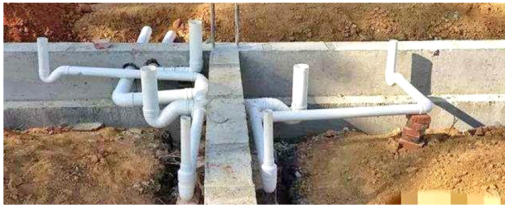
The design of the sludge discharge pipes may be inadequate.
Solution:
Modify the tank design to reduce sludge dead corners. Adopt gravity sludge removal with a large sludge hopper, which causes minimal disturbance to the water flow and is less likely to clog. The sliding angle for sludge removal should be greater than that of small sludge hoppers, ensuring complete sludge removal.
Use a scraper-type sludge removal mechanism, increasing the number of sludge removal trenches at the bottom of the tank to improve the efficiency of sludge removal.
