





By: Kate
Email:kate@aquasust.com
Date: 4th December 2024

1. Overview of the MBR Process
MBR (Membrane Bio-Reactor) is a membrane biological treatment technology used in water treatment. It is a system that combines membrane separation technology and wastewater biological treatment technology. It is recognized as one of the most advanced and efficient wastewater treatment and resource recovery technologies in the world today.
MBR technology utilizes the separation function of membranes, replacing traditional activated sludge processes' secondary sedimentation tanks, sand filters, disinfection units, and other components with membrane separation devices. It uses microfiltration/ultrafiltration (MF/UF) membranes to directly filter the effluent from the aeration tank. Suspended solids in the activated sludge mixture are completely retained and recirculated back into the reactor. As a result, the sludge age can be extended, the sludge concentration increased, and the sludge load reduced. This accelerates the microbial degradation of pollutants, significantly improves the wastewater treatment efficiency, and ensures that the effluent quality is not only stable and reliable but also meets the high-quality reclaimed water standards. It is especially suitable for upgrading wastewater treatment plants in China to meet the new discharge standards set in 2011, as well as for industrial wastewater reuse.
Microfiltration/Ultrafiltration (MF/UF) membranes have pore sizes and molecular weight cut-off ranges. Generally, the pore size of ultrafiltration membranes is between 0.01 to 0.1 μm, with a molecular weight cut-off (MWCO) range of 5,000 to 500,000 Dalton. The nominal MWCO of microfiltration membranes typically used in wastewater treatment ranges from 30,000 to 800,000 Dalton.
2. Advantages of MBR Membranes
MBR offers significant advantages that other standalone biological processes cannot match:
1.Excellent and Stable Effluent Quality
This is manifested in the high efficiency of solid-liquid separation. The effluent's suspended solids can almost always be maintained close to zero, and it is not easily affected by factors such as sludge decomposition or sludge bulking in the short term.
2.Compact Reactor Design
The reactor is more compact because it can operate normally at high sludge concentrations, resulting in high organic removal efficiency while saving space. There is no need for a secondary sedimentation tank system.
3.Favorable for Aerobic Nitrifying Bacteria Cultivation
The system enhances the nitrification capacity of the aerobic zone. This is reflected in the high efficiency of ammonia nitrogen removal, which remains stable over a long period.
4.Complete Separation of Hydraulic Retention Time and Sludge Retention Time
The complete separation of the reactor's hydraulic retention time (HRT) and sludge retention time (SRT) allows for more flexible operation control.
5.High Microbial Concentration and Strong Shock Load Resistance
The microbial concentration in the reactor is high, and it has strong resistance to shock loads. With a long sludge age, membrane separation ensures that large, hard-to-degrade molecules in the wastewater have sufficient retention time within the biologically limited reactor volume. This greatly improves the degradation efficiency of recalcitrant organic matter. The reactor operates under high volumetric loads, low sludge loads, and long sludge ages, which helps effectively reduce sludge discharge.
3. Future Development Trends of MBR Membranes
1.MBR Technology's Important Role in Wastewater Treatment
In recent years, experience has shown that MBR technology is mature, and successful design and operation are achievable. It can be used for the treatment of both municipal wastewater and industrial wastewater. Therefore, as MBR technology continues to develop and mature, it is expected to be widely applied globally as an economically efficient and practical technology.
2.Prospects for MBR Application
The primary application for MBR should be municipal wastewater treatment, especially because cities require small land areas for wastewater treatment. High-quality effluent can be reused or serve as a pre-treatment for nanofiltration and reverse osmosis, and strict discharge standards must be met.
MBR technology is also effective in treating industrial wastewater, such as food processing wastewater, slaughterhouse wastewater, and landfill leachate. It has demonstrated excellent removal efficiency for endocrine-disrupting substances (EDS) in landfill leachate and can remove nitrates in drinking water (with a removal rate of up to 98.5%).
3.Membrane Fouling Control
Further research is needed on the mechanisms of membrane fouling, particularly the study of biological fouling. More effective, controllable, and minimized membrane fouling solutions should be developed. The use of computer and sensor technology for online membrane fouling control should be fully explored. In improving cleaning methods, particular attention should be paid to the use of safe chemicals.
4.Selecting Membrane Structure and Materials Based on Wastewater Type
Membrane structure and materials should be correctly selected based on the type of wastewater. New energy-efficient, high-performance membrane materials and module assemblies should be adopted. The integration of aerobic and anaerobic MBR systems should be promoted. Additionally, mathematical models and computer technology should be fully utilized to optimize operating parameters to achieve better effluent quality, making the process more economical and efficient.


4. Operating Principle of MBR Membranes
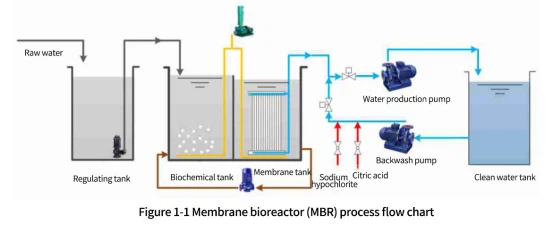
In practical engineering applications, the immersed MBR (Membrane Bio-Reactor) process is more commonly used, and industry experience with this type of system is relatively mature. Therefore, we will use this type of MBR as an example for analysis. The general principle is as follows:
Raw water enters the bioreactor, where the organic matter is oxidized and decomposed by the high-concentration mixed activated sludge. Below the membrane module is an aeration system, which not only provides sufficient dissolved oxygen (DO) for the microorganisms in the mixed liquor but also promotes thorough mixing. The agitation caused by the bubbles, along with the circulation flow formed on the membrane surface, has a scouring and shear effect on the membrane surface, effectively preventing the irreversible deposition of pollutants on the membrane surface under non-artificial conditions. The treated water is then drawn through a self-priming pump and separated by the membrane, with the liquid phase passing through the membrane and being discharged from the system.
Typically, the MBR process has several key operational parameters, including membrane flux, permeability coefficient, retention rate, and concentration polarization.
1.Membrane Flux
Membrane flux (J) refers to the amount of material passing through a unit area of the membrane per unit time. It is typically expressed in SI units as [m³/(m²·s)] or simplified to m/s. In practical engineering calculations, non-SI units are often used to measure flux, such as LMH (liters per square meter per hour), with units of [L/(m²·h)]. A typical MBR membrane that satisfies general wastewater treatment requirements has an LMH of at least 10 L/(m²·h).
The factors influencing membrane flux include the driving force for mass transfer, membrane resistance, the flow condition of the feed solution on the membrane side (equivalent to boundary layer resistance), and the extent of membrane fouling.
2.Permeability Coefficient
The permeability coefficient (Lp) of a membrane represents the quantity of material passing through the membrane per unit time and unit area under a unit pressure. It is simply expressed as the membrane flux under unit pressure conditions. The permeability coefficient is one of the main parameters for evaluating the current performance of the membrane.

3.Retention Rate
In the membrane separation process, the liquid passing through the membrane is called the permeate, and the liquid retained by the membrane is called the retentate. The retention rate is used to characterize the separation performance of the membrane, including the observed/reported retention rate (Robs) and the actual/intrinsic retention rate (Ract). Its definition is as follows:

Where Cp and Cb represent the solute concentrations in the permeate and feed solution, respectively, which can be directly measured. However, due to solutes being retained and adhering to the membrane surface, the solute concentration (Cm) on the membrane surface is higher than the average concentration of the feed solution. Therefore, the actual retention rate is:

The value of Cm is generally not directly measurable and needs to be estimated using a computational model.
4.Concentration Polarization
During actual pressure-driven processes, membrane flux often decreases over time, and the solute retention rate also changes. The main cause of this phenomenon is concentration polarization and membrane fouling.
Concentration polarization refers to the phenomenon in which, under pressure-driven conditions, the solvent in the feed solution passes freely through the membrane, while solutes are retained by the membrane. The solvent flow continually carries the solutes to the membrane surface, causing solute accumulation on the membrane. As a result, the solute concentration (Cm) on the membrane surface gradually increases, leading to a concentration gradient that causes reverse diffusion from the membrane surface to the feed solution. After a period of stabilization, when the flow of the feed solution to the membrane surface equals the reverse diffusion, a stable concentration polarization boundary layer is formed. The condition of complete retention is expressed by the following equation:
The ratio Cm/Cb is called the concentration polarization ratio. The higher the ratio, the more unfavorable it is for membrane separation.

Membrane flux (J) is easier to measure, but k is the ratio of diffusion coefficient to boundary layer thickness. The value of k is related to the flow conditions on the membrane surface and can be calculated using the mass transfer dimensionless number correlation or determined experimentally. Methods for determining k values can be found in the paper by Zeman and Zydney (1996).
