

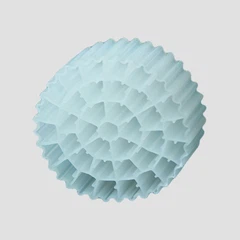




Elastic filler is developed on the basis of soft filler and semi-soft filler, which has the advantages of both. Its structure is to change the plastic disc press buckle into a double-circle large plastic ring, press the aldehyde fiber or polyester yarn on the ring of the ring, so that the fiber bundle is evenly distributed; the inner ring is made of snowflake-shaped plastic branches, which can be used for film , It can effectively cut air bubbles and improve the transfer rate and utilization of oxygen. The water and gas biofilm can be fully exchanged, and the organic matter in the water can be treated efficiently.
See the figure below for elastic packing. For the selection of elastic fillers, several corrosion-resistant, temperature-resistant, and aging-resistant varieties of polyolefins and polyamides are used, mixed with additives such as hydrophilic, adsorption, and thermal oxygen resistance, and special wire drawing and wire wool making processes are used. Interpenetrate the thread with the corrosion-resistant, high-strength central rope. Due to the excellent material selection and technical formula, moderate rigidity and flexibility, the filaments are arranged in a three-dimensional uniformly radiating state, and a monomer of suspended three-dimensional elastic filler is made. The filler can be spread uniformly in the effective area in three dimensions and all directions, so that air, water, and biofilm can be fully mixed and exchanged. The biofilm can not only uniformly implant on each thread, but also maintain good activity and gaps. Variability, and can obtain a large specific surface area during operation.
Compared with hard honeycomb packing, three-dimensional elastic packing has greater pore variability and no clogging; compared with soft packing, it has a long material life and does not stick to the group; compared with semi-soft packing, it has large surface area and rapid film formation , Low cost. Therefore, the filler can be confirmed to be the fourth-generation high-efficiency and energy-saving novel filler following various hard fillers, soft fillers and semi-soft fillers. At present, it is mostly used in the hydrolysis and acidification section in the treatment of refractory organics to improve the biodegradability of sewage.
Elastic fillers are used in sewage and wastewater treatment projects and are used in contact oxidation towers, oxidation tanks and oxidation tanks. It is a biological carrier for biological contact oxidation and anaerobic fermentation to treat wastewater. It is widely used as biological filler in biological contact oxidation tank and hydrolysis acidification tank.
The elastic filler is made of high molecular polymer and added with antioxidants, hydrophilic agents, stabilizers, adsorbents and other additives. The surface has a fine burr structure after special drawing. The elastic threads are bonded at high temperature and firmly fixed on the plastic particles. , Form a sheet-space elastic three-dimensional packing. The filler is corrosion-resistant, has a large specific surface area, is easy to hang the film, it is easy to take off the film after periodic, and it is updated quickly. It has good air and water distribution performance.