





By: Kate
Email:Kate@aquasust.com
Date: 7th November 2024

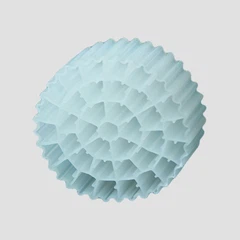
In the MBBR (Moving Bed Biofilm Reactor) process, designing an efficient aeration tank is crucial for pollutant removal. Proper configuration of MBBR media and aeration equipment (such as disc diffusers) can significantly improve oxygen transfer efficiency. Below are key design considerations for an efficient MBBR aeration tank, including specific calculation examples to help you quickly master the design approach.
1. Oxygen Demand Calculation: Meeting Pollutant Degradation Needs
The oxygen demand rate (ODR) determines the minimum oxygen supply required in the aeration tank and can be estimated based on the COD load of the influent:
ODR = COD × Q × 1.5
Where:
- COD: Chemical Oxygen Demand of influent (mg/L)
- Q: Wastewater flow rate (m³/h)
- 1.5: Oxygen demand coefficient
Case Calculation
Assuming COD is 300 mg/L and wastewater flow rate is 100 m³/h:
ODR = 300 × 100 × 1.5 = 45000 mg/h = 45 kg/h
This result means that the aeration tank needs to provide 45 kg of oxygen per hour to meet treatment requirements.
2. Oxygen Transfer Efficiency (OTE) and Required Air Volume
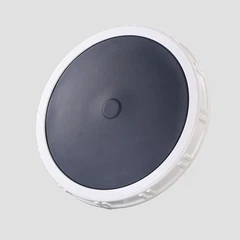
Oxygen transfer efficiency (OTE) is usually determined by the type of aeration equipment and water depth. Typically, fine bubble disc diffusers achieve 15%-25% OTE. The formula for required air volume is:
Q_air = ODR / (OTE × 0.233)
Case Calculation
Assuming an OTE of 20%:
Q_air = 45 / (0.20 × 0.233) ≈ 967 m³/h
This calculation shows that under these conditions, approximately 967 m³/h of air is required.
3. MBBR Media Flow Design: Ensuring Uniform Aeration
In an MBBR system, the mobility of the MBBR media is crucial. Media should be evenly distributed without clogging in the aeration tank, which can be achieved through proper diffuser placement. Using fine bubble disc diffusers can produce microbubbles, enhancing oxygen transfer efficiency and promoting even flow of media, which prevents uneven biofilm thickness.
4. Dynamic Airflow Adjustment: Reducing Energy Consumption
When wastewater concentration and flow fluctuate, adjusting airflow with an automatic control system can optimize energy use. Increasing aeration during higher loads and reducing it during lower loads ensures that oxygen supply meets treatment needs while minimizing energy consumption.
5. Depth Control: Optimizing Oxygen Transfer and Energy Consumption
Water depth impacts both aeration efficiency and energy use. Generally, maintaining aeration tank depth between 3-5 meters can enhance oxygen dissolution, but excessive depth increases energy consumption. Choosing an appropriate depth balances oxygen transfer with operational costs.
6. Preventing Foam Accumulation and Media Clogging
To prevent foam buildup and media clogging, surface defoaming devices can be installed at the top of the aeration tank, and regular cleaning of disc diffusers is recommended. Optimized aeration equipment and strategic placement help minimize foam formation and maintain efficient system operation.