






Tube settlers and parallel plates increase the settling capacity of circular clarifiers and/or rectangular sedimentation basins by reducing the vertical distance a floc particle must settle before agglomerating to form larger particles.
Tube settler design involves the use of multiple tubular channels sloping at an angle of 60 degrees and adjacent to each other. This helps in increasing the settling area effectively. Tube settler design reduces the depth significantly compared to the conventional clarifier. This helps in reduction of settling time.
Due to the structural optimization, the high-efficiency inclined plate precipitation equipment has no lateral constraints, which is more conducive to the sedimentation and separation of alum.
Tube settlers have in general an advantage over plate settlers regarding equal flow distribution. Because tube settlers consist of several smaller channels the water flow is split between each channel resulting in similar flow velocities throughout each channel of the tube settler. However, plate settlers consist of large layers which favor zones of higher flow velocities (short circuiting) and zones of little or no upward flow velocity at all (Deadzones).
In a new clarifier design, the use of Tube settler can reduce the cross sectional area of the tank substantially, hence reducing civil costs and minimizing space requirements, while still maintaining a high quality effluent.
It is possible to cut coagulant dosage by up to half while maintaining a lower influentturbidity to the treatment plant filters.
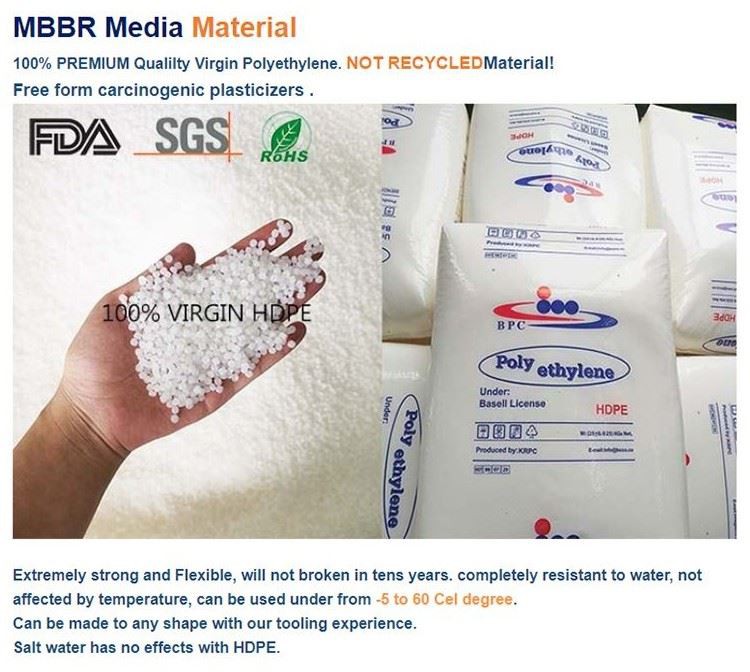
Each individual bio carrier increases productivity through providing protected surface area to support the growth of heterotrophic and autotrophic bacteria within its cells. It is this high-density population of bacteria that achieves high-rate biodegradation within the system, while also offering process reliability and ease of operation. Medium or coarse bubble diffusers uniformly placed at the bottom of the reactor maintains a dissolved oxygen (DO) concentration of > 2.5-3 mg/L for BOD removal. Still higher DO concentrations are maintained for nitrification. To retain the media flowing out of the tank, screens are placed on the downstream walls. A clarifier or a DAF is placed downstream of the MBBR tank to separate the biomass and the solids from the wastewater. No sludge recycle is required for this process. A typical MBR Media is shown below.


Packing performance
Filler performance-the most important index for evaluating the biological adhesion of filler
(1) Filler surface performance
1. Surface structure: It is generally considered that the surface roughness is large and the film hanging speed is fast.
2. Surface potential: Generally, microorganisms are negatively charged, and the surface of the filler is positively charged, which is suitable for the growth of microorganisms.
3. Hydrophilicity: Microbes are hydrophilic particles, and the filler has good hydrophilicity and is suitable for microbial growth and filming.
(2) Hydraulic performance
1. Porosity: The volume occupied by the filler, the porosity is high.
2. Shape and size: Affect the flow state of water flow and air flow.
(3) Fluidization performance: It is related to the density of the filler. The density of the filler should be 0.97-1.03, and fluidization can be achieved with less aeration or stirring.
Hot Tags: hdpe mbbr k3 sewage disposal, China, suppliers, manufacturers, factory, cheap, in stock, free sample