







There are also anaerobic MBBRs that have been mainly used for industrial wastewater treatment.[5] A 2019 article described a combination of anaerobic (methanogenic) MBBR with aerobic MBBR that was applied in a municipal wastewater treatment laboratory, with simultaneous production of biogas.
The biofilm carriers can be loaded into complete mixed bioreactors at a minimum fill ratio of 25% v/v to the overall working volume of the tank. Future expansion of bioFAS™ MBBR capacity can be achieved by addition of biomass carriers up to 75% v/v and increasing the air supply.
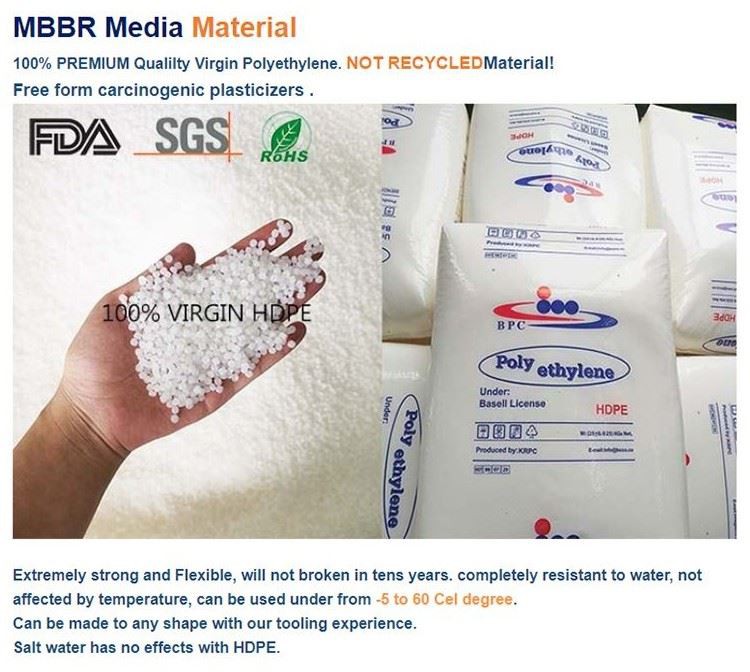
Getting the mbbr media full form, you are acquiring a minimal cost in investing it, during operation, its maintenance, and including its replacement when possible. The complete mbbr media material provides massively reliable and vigorously sturdy operation procedure.
As we've discussed above, the design and shape of MBBR bio media carriers help determine waste breakdown efficiency and effectiveness. Media carriers with intricate, cut-out shapes tend to offer more surface area per media weight to enhance bacterial growth and promote biosolid breakdown.
Having a sieve on the outlet of the tank will add a better performance and is plainly necessary to put hold on the plastic carriers from breaking free of the aeration process.
supplied in 1 m3 super sacks and shipped on pallets for ease of transportation. The carriers can be loaded into basins and tanks via a fork truck or a crane.
Using MBBR media is particularly advantageous because the tiny pieces take up minimal space, are easy to maintain and digest waste efficiently. The microorganisms on the media can also automatically adjust to changes in the amount and type of waste in the water. Although MBBR systems require some monitoring, they are largely self-sufficient.
a


| FAST START OF MBBR |
1. Filler release stage
-When the filler is added, observe whether there is accumulation, and stop feeding once it occurs. Wait for the next day to continue to observe before adding.
-When filling the filler, use intermittent aeration, and aeration can be continued at night, but the aeration volume needs to be reduced.
-After running for 24 hours, continue to feed water for 2-3 hours, and then continue the above-mentioned aeration. After running for 48 hours, observe the film formation on the filler, increase the water intake to extend the water intake time, and check the dissolved oxygen status in the pool. It is best to keep it around 1.5-2.0mg/L. After 72 hours of operation, contact the inlet water and gradually add it to the design requirements. According to the routine inspection of the water quality of the inlet and outlet water, it is expected that the design water quality requirements will be met in about 7 days.
2. The cultivation stage of biofilm
The so-called cultivation of biofilm is to produce and accumulate a certain amount of microorganisms in the treatment system through certain means, so that the biofilm on the filler reaches a certain thickness, and its cultivation methods mainly include static cultivation and dynamic cultivation.
*Static cultivation
The so-called static culture is: in order to prevent the new microorganisms from running away with the water, as much as possible to provide the contact time between the microorganisms and the filler layer, in order to accelerate the formation of biofilms, in the initial stage, in order to avoid the single nutrition of wastewater, so C:N: P=100:5:1 ratio of adding nutrient substrates such as urea, diamine and sugar. First, inoculate sludge (10% biochemical effective volume) and waste water pump into the biochemical tank, and then start aeration culture. The stacking volume of the filler in the biochemical tank is 35%-40% of the effective volume of the reaction tank. Let stand for 4-5h without aeration to inoculate immobilized microorganisms on the filler, then aerate for 1h, then stand for 2h, aerate for 1h, and repeat the operation. After 4-5 days, the surface of the filler has all been covered with biofilm. Continuous small water inflows started from 6 days.
*Dynamic training
After 6 days of boring culture, a thin layer of yellow-brown biofilm has grown on the surface of the filler, so it is changed to continuous water inflow, dynamic cultivation, adjust the amount of water, and control the dissolved oxygen between 2~4mg/L (use Dissolved oxygen meter measures dissolved oxygen). After about 15 days, there were some amoeba and roaming insects on the filler (observed with a biological microscope), and the filler felt sticky and slippery when touched by hand. After 20 days, protozoa such as flagellates, bellworms, and paramecium free bacteria appeared. After 20 days of cultivation, metazoans such as rotifers and nematodes appeared, which indicated that biofilms had grown. Can start continuous industrial operation.
3.The domestication stage of biofilm
The purpose of domestication is to select microorganisms that adapt to the actual water quality, eliminate useless microorganisms, and make nitrifying bacteria, denitrifying bacteria, and phosphorous accumulating bacteria become the dominant flora through domestication for treatment processes that have the function of denitrification and phosphorus removal. The specific method is to maintain the normal operation of the process first, and then strictly control the process control parameters. The average DO should be controlled between 2~3mg/l, and the aeration time of the aerobic tank should not be less than 5 hours. During this process, do it every day For the determination of various water quality indicators and control parameters, when the average thickness of the biofilm is about 0.2-0.5mm, the biofilm cultivation will be successful, until the effluent BOD5, SS, CODCr and other indicators meet the design requirements.
Hot Tags: excellent quality fish farm bio filter for sewage, China, suppliers, manufacturers, factory, cheap, in stock, free sample, HDPE MBBR Media