





By: Kate
Email:kate@aquasust.com
Date: 13th November 2024
Industrial and domestic activities consume vast amounts of water resources and generate significant wastewater, leading to issues of water scarcity and declining water quality in many countrys. Therefore, achieving pollution-free treatment and recycling of wastewater is an urgent problem that needs to be addressed. The method of coagulation and sedimentation is simple to operate and cost-effective, widely applied in industrial wastewater treatment. Commonly used coagulants can be classified into three main categories: inorganic coagulants, organic polymer coagulants, and microbial coagulants. Among these, the low-cost inorganic coagulants are currently the most widely used, while organic coagulants exhibit the best treatment effects. Microbial coagulants are still in the laboratory research phase. The development of efficient, safe, and economical new composite coagulants is the main trend for the future of coagulant development.
Classification of coagulants
The most widely accepted mechanism of coagulation involves two processes: coagulation and flocculation. The coagulation process refers to the destabilization of colloidal particles and the formation of small aggregates; the flocculation process involves these small aggregates linking together under the influence of the coagulant to form larger flocs. The primary mechanisms of coagulants include the compression of the double electric layer, the adsorption-bridging effect, and sweeping flocculation, which destabilize the colloidal particles in water, leading to their aggregation and settling, thus achieving the flocculation effect. Common coagulants can be classified into three main categories: inorganic coagulants, organic polymer coagulants, and microbial coagulants.
01 Inorganic Coagulants
The action principle of inorganic coagulants includes double electric layer compression and charge neutralization. The coagulants form counter-ions in wastewater, which compress the double electric layer, resulting in a decrease in the zeta potential of the colloids, causing the hydration layer on the surface to disappear, destabilizing the colloids. Subsequently, charged colloidal particles aggregate through intermolecular interactions and electrostatic forces to form large, dense flocs.
Inorganic coagulants can be categorized based on different criteria: by anionic composition, they can be divided into sulfate-based and chloride-based; by molecular weight, they can be classified into high molecular and low molecular; and by the type of metal salts, they can be categorized into iron salts (such as ferric chloride, ferrous sulfate, and ferric sulfate) and aluminum salts (such as aluminum sulfate, potassium aluminum sulfate, and sodium aluminate).
Flocs formed by iron salts are large and dense, requiring less dosage, and they perform well at low temperatures with a wide suitable pH range (between 5.0 and 11). However, iron salts can be corrosive to equipment, necessitating close monitoring of the condition of equipment and pipelines during use. Aluminum salts have shorter settling times and lower color after treatment, but their effectiveness is highly pH-dependent. Additionally, high residual levels of Al³⁺ in water can lead to secondary pollution, potentially causing Alzheimer's disease and anemia upon entering the human body, so special care must be taken to avoid secondary pollution.
These low molecular weight coagulants are inexpensive and widely sourced but have issues such as high usage amounts, significant sludge production, and poor effectiveness. Therefore, there is a gradual shift from low molecular to high molecular inorganic coagulants. Currently, commonly used high molecular inorganic coagulants include polymeric aluminum coagulants, polymeric iron coagulants, reactive silica coagulants, and composite coagulants. Their action primarily relies on the bridging effect, exhibiting advantages such as less pH and temperature sensitivity, stable adsorption effects, lower dosage, and less residual color. In recent years, the production scale of high molecular inorganic coagulants has gradually increased, accounting for 80% of total coagulant production, especially showing significant effects in treating high-turbidity wastewater.
02 Organic Polymer Coagulants
The action principles of organic coagulants primarily include:
(1)adsorption of colloidal particles through hydrogen bonding, electrostatic interactions, and van der Waals forces;
(2) the polymer chain segments facilitate particle settlement through a bridging adsorption mechanism. Compared to inorganic coagulants, organic polymer coagulants have advantages such as better treatment efficacy, shorter flocculation time, suitability for low temperatures, a wide pH range, and less sludge production.
Organic polymer coagulants can be divided into two categories: natural modified polymer coagulants and synthetic polymer coagulants. Synthetic polymer coagulants have controllable and relatively high molecular weights, and they can introduce a larger number of functional groups into the chain segments, providing excellent flocculation effects. Currently, the most representative synthetic polymer coagulant in the Chinese market is polyacrylamide (PAM) and its derivatives, which account for 80% of the total market.
In contrast to synthetic polymers, which have high production costs and environmental toxicity, natural modified polymer coagulants have advantages such as wide availability, lower costs, safety, non-toxicity, and customizable molecular characteristics. Natural modified polymer coagulants mainly include starch derivatives, chitosan, cellulose, guar gum, and other plant-based gums, proteins, and algae, all of which can be sourced from plants and animals.
For example, modified starch molecules can achieve excellent flocculation effects; cationic etherified starch and its derivatives can effectively flocculate negatively charged particles, while branched starch structures have strong flocculation effects on heavy metal ions such as copper, mercury, and lead. Starch graft copolymers copolymerized with other monomers can also effectively remove heavy metal ions. Chitosan modification can be achieved through methods such as grafting, esterification, crosslinking, and alkylation. Various types of natural polymer coagulants can obtain a range of desired properties through chemical modification and modification to meet the needs of practical production and daily life.
03 Microbial Flocculants
Microbial flocculants are high molecular weight products and biomass generated by the growth and metabolism of specific cultured microorganisms at a certain stage. They can cause the aggregation and sedimentation of solid suspended particles in wastewater, thereby achieving the purpose of purifying water bodies. Microbial flocculants have a wide range of sources and are cost-effective; they are generally composed of polysaccharides, proteins, DNA chains, glycoproteins, and polyamino acids. They can degrade naturally without causing secondary pollution.
There are many microorganisms capable of producing flocculants, which can be easily industrialized through route design. However, research on microbial flocculants in China is still limited, and current studies are mostly at the laboratory level, far from achieving industrial production.

Development Prospects of Flocculants
Flocculants have a wide range of applications in wastewater treatment, effectively removing various suspended or soluble impurities, metal ions, bacteria, viruses, and other pollutants. They help achieve deoxygenation, decolorization, and phosphorus removal, resulting in non-polluting and resource-efficient wastewater treatment. With ongoing research progress, the types of flocculants used in wastewater treatment in China have transitioned from low-molecular inorganic flocculants to high-molecular organic flocculants and from single to composite types, aiming for efficiency, cost-effectiveness, and environmental friendliness.
Compared to inorganic flocculants and widely used synthetic high-molecular flocculants, natural high-molecular flocculants have distinct advantages such as wide availability, low cost, safety, non-toxicity, and environmental friendliness. Industrial wastewater is often large in volume, complex in composition, and consists of stable dispersions; thus, a single flocculant may not effectively remove all components.

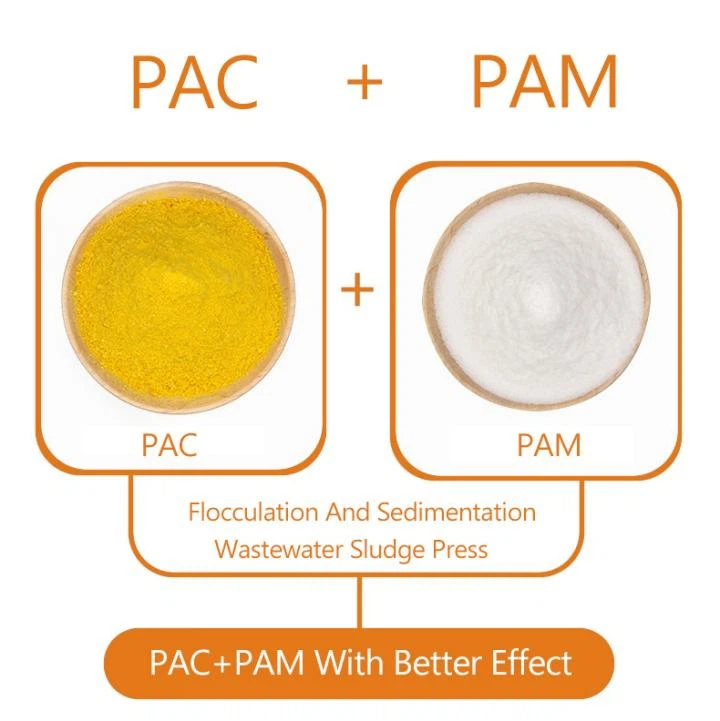
Recently, there has been a trend towards using inorganic-organic and inorganic-microbial composite flocculants, leveraging the synergistic effects of inorganic-organic flocculants. First, inorganic flocculants neutralize charges and aggregate impurities into large molecular clusters, followed by organic high-molecular flocculants capturing these clusters through bridging action for effective sedimentation. The use of inorganic flocculants can reduce the quantity of organic flocculants needed, achieving optimal results at a lower cost. However, specific formulations and dosages must be continuously tested according to wastewater types.
Currently, polyaluminum chloride-polyacrylamide composite flocculants are commonly used and show good effectiveness; however, they pose certain environmental risks. Future research could focus on combining polymeric silica inorganic flocculants with natural organic high-molecular flocculants to enhance environmental friendliness. If the industrial production of microbial flocculants can be achieved, inorganic-microbial composite flocculant systems should also yield excellent treatment results.
The deterioration of water quality due to human production activities has made the non-polluting and resource-efficient treatment of wastewater an urgent issue. The use of appropriate flocculation methods and agents can achieve excellent treatment results at low costs. Currently, flocculants have transitioned from low molecular weight to high molecular weight and from single-type to composite-type, effectively removing suspended and dissolved impurities, heavy metals, and colors from wastewater.