






By: Kate
Email:kate@aquasust.com
Date: 10th March 2025

One of the key treatment steps in recirculating aquaculture system plants is efficient and gentle particle removal. It is important to get the particles out as quickly as possible so that they are not degraded into finer particles or broken down by bacteria in the water.This addresses some of the differences between using a drum filter and a disc filter in a Aquasust context.
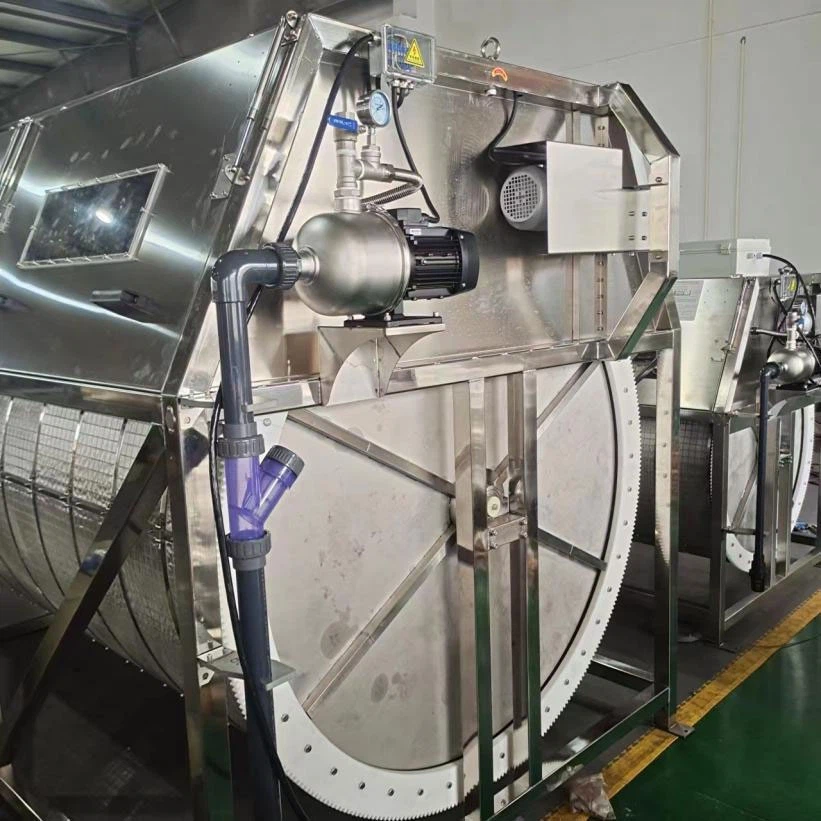
Microscreens have been used for aquaculture for a long time. The drum filter, especially, is extensively applied both for inlet and effluent treatment in flow-through plants, and for particle removal internally in re-use and RAS plants. Although the drum filter is one of the most widely used particle removal technologies in RAS today, there is another well-prover microscreen that may have advantages especially in the RAS system of the future.This ist he disc filter.
As the name indicates, the drum filter is built around a drum-shaped skeleton enclosed with external filter panels. The untreated water flows into the drum, and gravity drives the water through the filter panels and out of the drum. In the disc filter,the influent water also enters a central drum.The drum has a number of openings that distributes the water to the filter discs .The disc segments are made up of several filter cassettes with filter cloth on both sides.This increases the filter area considerably.
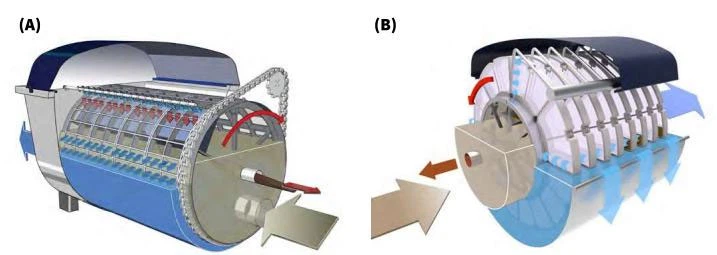
Figure 1A. Principle of drum filter.Theimpure water enters the drum(grey arrow)and is filtered through the cloth attachedto the drum(blue arrows). Particlesgradually accumulate on the filtercloth,which increases the water levelinside the drum. When the water levelreaches a given level, the drum starts torotate at the same time as the backwash isstarted(red/brown arrows). The drumfilter backwash nozzles are normallylocated in an upper corner so that theyspray obliquely downwards towards thecentre of the filter
Figure 1B. Principle of a disc filter. Theuntreated water flows the middle of the drum(grey arrow)and is distributed into thediscs with filter cassettes where it isfiltered(blue arrows). Since the discfilter has standing cassettes with cloth ontwo sides, they are sprayed from both sidesby nozzles placed between the discs.Backwashing takes place when the filtermesh is rotated to the top position so thatthe reject falls out of the cassettes andstraight into a trough that directs thewater into the hollow drum shaft and out ofthe filter (brown arrow)
The water is filtered passively through the filter cloth in asimilar manner as for the drum filter. However, the disc filterhas a significantly larger filter area which provides a moreefficient filtration, or alternatively a smaller footprint.As particles accumulate on the filter cloth and the resistanceincreases, the water level inside the filter will rise withtime.Common to both types of filters is that a backwash cycleis automatically initiated when the water level reaches a certain level.
The filter panels are then sprayed from the outside to cleanthe filter cloth. Reject water containing particles scollectedin a long trough located inside the filter,along which it exits,e.g. to a collection tank for further sludge treatment.
Larger filter area in a smaller space
A disc filter has more than three times the filter area of adrum filter with a corresponding footprint. It is thereforepossible to use much finer cloth in the disc filter and stillensure favourable overcapacity in relation to the filter
area.This prevents the differential pressure.
from increasing too much over time as a result of fouling ofthe mesh. For example,it is possible to use 30 to 50-microncloth instead of 60-micron whichi s widely used in drum filters.In general, fewer and smaller units of disc filters will beneeded when compared to drum filters. Being able to take up lessspace for filter installations can also have other positiveeconomic aspects,for example by reducing the size of the
building and the plant site.

Backwash water and energy consumption
Tests with water have shown that a disc filter consumes 45% lessbackwash water than a drum filter while extracting the sameamount of suspended matter.
The tests were performed in parallel with water from the samefish tank.The reject water was collected, and the sludge volumewas measured after sedimentation. Following a proper mixing ofthe sediment, a sample was taken to measure the concentrationof suspended solids (SS). The trial was repeated 10 times. Theresult showed that the SS concentration in this experiment wasalmost twice as high in the reject water from the disc filtercompared to the drum filter.
So, what are the benefits of being able to minimise the amountof reject water beyond reducing the water consumption?
Firstly, the operating cost is reduced corresponding to thereduction of the backwash water.The energy consumption - whichis mainly spent on pumping backwash water and rotating the
drum-is therefore 45% lower in a disc filter than in a drumfilter.
Secondly, there will be less volume of sludge that must be
stored and dewatered. This in turn can reduce the need to investin sludge storage and dewatering equipment.
Rapid removal of large solids
In RAS,rapid particle removal is essential to maintain goodwater quality.The aim should be to remove the faeces that thefish produce as possible. This reduces the risk of large matterthat is more difficult to remove from the system.
To learn more about what this system might look like for yourfacility, request an Drum filter or disc filter quote today.You can also contact a representative who would be happy toanswer your questions concerning filter and other wastewatertreatment methods. Aquasust is a company you can trust for thevery best in modern wastewater treatment plant equipment.