







Email: Shirley@aquasust.com
Whatsapp: +86 13600513715
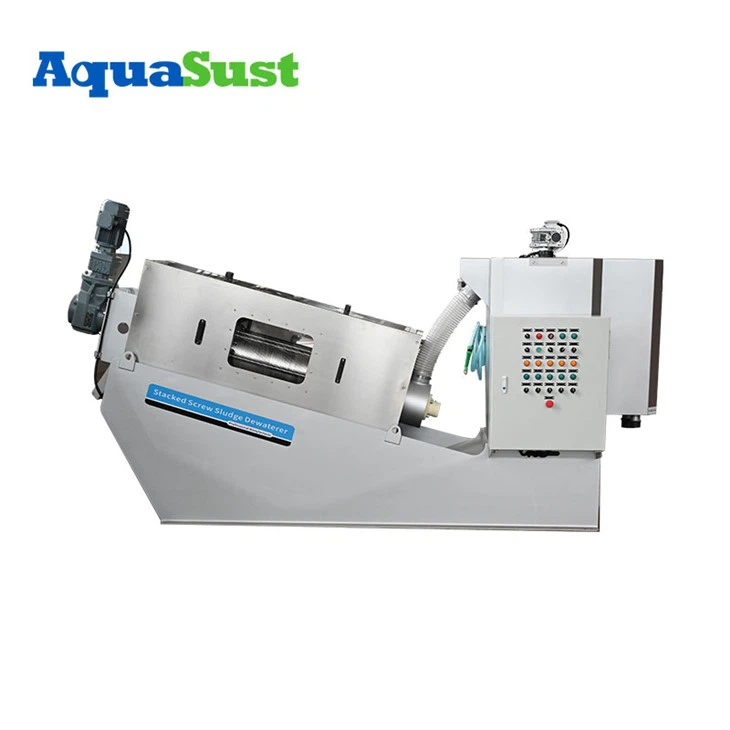
DEWATERING SCREW PRESS Working Principles
The screw sludge dewatering machine is a type of equipment used for sludge treatment, which separates water from sludge through physical methods, thereby reducing the volume of sludge and facilitating further treatment or disposal. Its working principle includes the following steps:
Sludge Feeding: Sludge is first fed into the inlet of the screw dewatering machine, entering the treatment system of the machine.
Adjusting Sludge Concentration: Flocculants are added to begin the separation of solids and liquids in the sludge. Flocculants cause the tiny particles in the sludge to aggregate into larger flocs, facilitating the separation of water.
Screw Conveying and Compression: Inside the screw dewatering machine, there are one or more rotating screw shafts. When sludge is fed into the machine, the screw shaft starts to rotate, conveying the sludge forward within the machine through its spiral action. During the conveyance, the gradually decreasing gap between the screw shaft and the machine wall, along with specifically designed pressure plates, compress the sludge, forcing the water out.
Separation and Discharge of Water: During the compression process, water is separated from the sludge through a mesh or other filtration structures and is discharged from the machine's water outlet.
Discharge of Dewatered Sludge: After compression, a significant amount of water has been removed from the sludge, making it drier. This drier sludge moves towards the machine's discharge end with the rotation of the screw shaft and is discharged from the outlet, completing the dewatering process.
The screw sludge dewatering machine is widely used in various industries, such as wastewater treatment plants, chemical, food processing, etc., due to its simple structure, easy operation, low maintenance cost, and high dewatering efficiency. This physical dewatering method effectively reduces the cost of sludge treatment and disposal, and is also beneficial for environmental protection.
The filtered sludge cakes will be pushed forward bythe finally discharged from the end.
DEWATERING SCREW PRESS Description
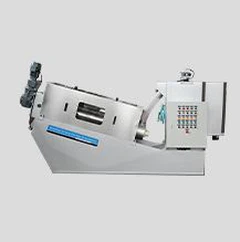
Aquasust Multi-Disc Sludge Dewatering Screw Press is a type of screw press that is designed to prevent clogging and reduce the need for sedimentation and sludge thickening tanks, thereby lowering construction costs for sewage treatment facilities. Utilizing a combination of a screw mechanism and moving rings for self-cleaning to maintain a clog-free operation, this equipment is automatically controlled by a PLC system. As a modern technology, it serves as an alternative to traditional filtration methods such as belt presses and frame presses. With its low screw speed, it operates with lower electricity and water usage compared to centrifuges, making it an advanced and efficient sludge dewatering solution.
 |
Sludge dewatering machines, including technologies like screw presses, belt filter presses, and centrifuges, are used in various sectors to reduce the water content in sludge, thereby minimizing disposal costs and facilitating easier handling. Here are some of the primary application areas: Municipal Wastewater Treatment: They are extensively used in municipal sewage treatment plants to dewater primary and secondary sludge, which helps in reducing the sludge volume before disposal or further treatment, such as composting or incineration. Industrial Wastewater Treatment: Various industries, including food and beverage, pharmaceuticals, chemicals, textiles, and more, generate sludge that needs to be treated. Sludge dewatering machines are crucial for managing industrial sludge, ensuring that the byproducts of industrial processes are handled in an environmentally responsible manner. Agriculture: In the agricultural sector, sludge dewatering equipment is used for treating animal waste, particularly in large-scale livestock operations. The processed sludge can be used as a fertilizer, contributing to sustainable agricultural practices. Oil and Gas: The oil and gas industry uses these machines for treating drilling muds and other waste materials, helping to recover valuable components and reduce waste. Mining: In mining operations, sludge dewatering equipment is used to manage the slurry produced in the extraction process, allowing for the recovery of water and minerals and reducing environmental impact. Paper and Pulp: The paper and pulp industry produces significant amounts of sludge in the paper manufacturing process. Dewatering equipment is used to reduce the moisture content of this sludge, making it easier to handle and dispose of. Marine and Shipping: Used for treating bilge water and sludge generated onboard ships, helping to meet environmental regulations regarding the discharge of wastewater at sea. The versatility and efficiency of sludge dewatering machines make them indispensable in these and other sectors, playing a critical role in waste management and environmental protection efforts. |
Advantages:
●Enclosed to minimize odors and noise Very low wash water usage (1/8 compared with belt press)
●Very low power consumption (1/20 compared with centrifuge)
●High cake solids
●Easy to operate and maintain
●Auto Start-up, Run and Shutdown
●Touchscreen operation optional
●Sludge Flow and Cake Monitoring Systems
●Available with many other options like Dairy, Palm Oil, etc.

Technology Advantages
Sludge Concentration 2000mg/L-50000mh/L
●Replacing gravity type dehydrator to realize effcient concentration of sludge.
●Flocculation and concentration operating together makes dewatering easy.
Rings substitute filter cloth, self cleaning, no clogging, easy treatment

Low speed operation, low noise, low energy consumption, only 1/8 of the belt type, 1/20 of the centrifuge
Semi-Automatic PET Bottle Blowing Machine Bottle Making Machine Bottle Moulding Machine PET Bottle Making Machine is suitable for producing PET plastic containers and bottles in all shapes.

Comparison Chart

Reduce the cost of infrastructure investment, improved the result of treatment
●The dewatering screw press can directly treat the sludge from the aeration tank and the sedimentation tank so that the sludge thickening tank is not needed any more. Therefore, the construction cost can be greatly reduced and well avoided the phosphorus releasing problem.
●Saving the cost of sludge thickening tank and other equipments investment.

Fully automatic control, easy operation and maintenance
The dewatering screw press has no easy-blocking components like filter cloth or filtration pore inside.
Its operation is safe and easy. It also can be set to operate automaticallyvia the elec-control cabinet.

Integral construction

Technical Parameters
| Type | Discharge height(mm) | Dimension | Weight(kg) | Total power(kw) | Washing waterconsumption (Lh) | |||
| L(mm) | W(mm) | H(mm) | Empty | Operation | ||||
| JTD-131 |
250 |
1860 |
750 |
1080 |
180 |
300 |
0.2 |
24 |
| JTD-132 |
250 |
1960 |
870 |
1080 |
250 |
425 |
0.3 |
48 |
| JTD-133 | 250 |
1960 |
920 |
1080 |
330 |
580 | 0.4 |
72 |
| JTD-201 |
350 |
2510 |
900 |
1300 |
320 |
470 |
1.1 |
32 |
| JTD-202 |
350 |
2560 |
1050 |
1300 |
470 |
730 |
1.65 |
64 |
| JTD-203 |
350 |
2610 |
1285 |
1300 |
650 |
1100 |
2.2 |
96 |
| JTD-301 |
495 |
3330 |
1005 |
1760 |
850 |
1320 |
1.3 |
40 |
| JTD-302 |
495 |
3530 |
1290 |
1760 |
1300 |
2130 |
2.05 |
80 |
| JTD-303 |
495 | 3680 |
1 620 |
1760 |
1750 |
2880 |
2.8 |
120 |
| JTD-304 |
495 |
3830 |
2010 |
1760 |
2300 |
3850 |
3.55 |
160 |
| JTD-351 |
585 |
4005 |
1100 |
2130 |
1100 |
1900 |
1 .3 |
72 |
| JTD-352 |
585 |
4390 |
1650 |
2130 |
1900 |
3200 |
2.05 |
144 |
| JTD-353 |
585 |
4520 |
1980 |
2130 |
2550 |
4600 |
2.8 |
216 |
| JTD-354 |
585 |
4750 |
2715 |
2130 |
3200 |
6100 |
3.55 |
288 |
| JTD-401 |
759 |
4680 |
1110 |
2100 |
1600 |
3400 |
1 .65 |
80 |
| JTD-402 |
759 |
4960 |
1760 |
2100 |
2450 |
5200 |
2.75 |
160 |
| JTD-403 |
759 |
5010 |
2585 |
2100 |
3350 |
7050 |
3.85 |
240 |
| JTD-404 | 759 | 5160 | 3160 | 2100 | 4350 | 9660 | 4.95 | 320 |
Technical Parameters
Sludge process
Sludge treatment in wastewater involves several steps: pretreatment, thickening, stabilization, dewatering, and final disposal. Different machines and technologies are required for each step, as detailed below:
Pretreatment:
Purpose: To remove coarse solids and sand from the sludge to prevent damage to subsequent treatment equipment.
Machines: Grilles, fine screens, sand-water separators, etc.
Thickening:
Purpose: To increase the proportion of solids in sludge through physical or chemical methods, reducing the total volume of sludge.
Machines: Thickening tanks (such as gravity thickening tanks, flotation thickeners), belt thickeners, screw thickeners, etc.
Stabilization:
Purpose: To reduce the activity of organic matter in sludge, decreasing odors and the content of pathogens.
Methods and Equipment:
Biological Stabilization: Aerobic digestion tanks, anaerobic digestion tanks.
Chemical Stabilization: Treatment with lime or other chemicals.
Dewatering:
Purpose: To further remove water from sludge, reducing its volume for easier transport and disposal.
Machines: Belt dewatering machines, centrifugal dewatering machines, screw press dewaterers, filter belt presses, plate and frame filter presses, etc.
Final Disposal:
Purpose: To safely recycle or dispose of treated sludge.
Methods and Equipment:
Land Application: Use as a soil conditioner or fertilizer.
Incineration: Sludge incinerators.
Landfill: Dedicated sanitary landfills.
Others: Such as brick making, building materials, etc.
The choice of machines and technology for each step may vary based on actual treatment requirements and regulatory standards. For example, the choice between aerobic digestion and anaerobic digestion in the stabilization process depends on the characteristics and quantity of sludge, and the choice of final disposal method also considers economic, environmental impact, and feasibility factors. Thus, sludge treatment is a comprehensive process that requires the flexible selection of appropriate treatment methods and equipment based on specific circumstances.
When using a screw sludge dewatering machine, adhering to certain operational and maintenance precautions is crucial to ensure the normal functioning and dewatering effectiveness of the equipment:
Pre-operation Check:
Before starting the screw dewatering machine, check the power supply, control system, and mechanical components to ensure everything is functioning normally and all safety devices are in good condition.
Adjustment of Flocculants:
Adjust the type and dosage of flocculants according to the properties of the feed sludge to improve the dewatering efficiency and effect.
Control Feed Rate and Concentration:
Adjust the feed rate and sludge concentration according to the machine's design capacity and the sludge's characteristics to avoid overloading.
Regular Cleaning:
Regularly clean the screw and filter mesh to remove accumulated sludge and impurities, keeping the equipment clear.
Monitor Operational Status:
During operation, regularly check the machine's operational status, such as vibration, noise, and temperature, to timely identify and address any abnormalities.
Maintenance and Care:
Perform regular maintenance and care as directed and recommended by the manufacturer, including lubrication and replacing worn parts, to extend the equipment's lifespan.
Operator Training:
Ensure operators are properly trained, understanding the equipment's working principle, operating procedures, and safety precautions.
Handling Abnormalities:
If equipment malfunctions or poor dewatering performance is observed, immediately stop the machine for inspection, and adjust or repair as needed.
Environmental Protection Measures:
Take measures to minimize environmental impact during operation, including proper handling of wastewater and waste produced during the dewatering process.
Safe Operation:
Follow all safety operational procedures, wear appropriate personal protective equipment, and prevent accidents during operation.
Following these precautions can help enhance the working efficiency of the screw sludge dewatering machine, prolong its service life, and ensure the safety of the operators.
When using sludge treatment equipment, following a set of standards is crucial to ensure effective treatment, extend equipment life, and guarantee operational safety. Below are some general standards for using sludge machines:
Pre-operation Preparation:
Ensure all equipment parts are intact and undamaged, especially important safety devices.
Check the equipment according to the manual to ensure there are no blockages.
Check that the power connections and control system are functioning properly.
Adjust Processing Parameters Appropriately:
Adjust the operating parameters of the equipment based on the characteristics of the sludge (such as concentration, viscosity, etc.) and treatment requirements.
Use flocculants or other chemicals in appropriate amounts to improve treatment efficiency.
Regular Monitoring and Maintenance:
Regularly monitor the operating conditions of the equipment, including temperature, pressure, flow rate, and electricity consumption.
Regularly clean the equipment, especially the filtration components, to prevent clogging and wear.
Periodically replace or repair worn parts.
Record Keeping:
Keep records of equipment operation data and maintenance activities to track performance and predict maintenance needs.
Operator Training:
Ensure that operators have received professional training, understand the working principles of the equipment, operating methods, and safety procedures.
Safe Operation:
Follow safety procedures for equipment operation and use personal protective equipment.
Ensure the equipment is completely powered off before maintenance and use the lockout/tagout system as required.
Environmental Protection:
Take measures to minimize the environmental impact during the treatment process and properly handle generated waste.
Emergency Shutdown and Fault Handling:
Be familiar with the equipment's emergency shutdown procedures and basic fault diagnosis methods.
In case of equipment failure, immediately stop the machine and proceed with troubleshooting according to the fault clearance guide.
Post-treatment and Disposal:
Dispose of the treated sludge according to local environmental standards and requirements.
Continuous Improvement:
Continuously improve operating methods and maintenance strategies based on operational experience and data analysis to optimize equipment performance and treatment efficiency.
Adhering to these standards ensures that sludge treatment equipment operates safely and efficiently, while also contributing to environmental protection and sustainable development.
The service life of sludge treatment equipment is influenced by various factors, including equipment design, material quality, operating conditions, and the frequency and quality of maintenance. Under normal circumstances, well-designed sludge treatment equipment, such as screw dewatering machines and belt filter presses, typically have an expected lifespan of 10 to 15 years. However, the actual lifespan can be longer or shorter, depending on the following factors:
Design and Manufacturing Quality:
High-quality materials and advanced design can significantly extend the service life of the equipment.
Operating Conditions:
The lifespan of equipment is affected by operating conditions. Frequent overloading, processing highly corrosive or abrasive materials can accelerate wear and aging.
Maintenance and Care:
Regular and proper maintenance is key to extending the service life of equipment. Neglecting maintenance can lead to early failure and performance degradation.
Environmental Factors:
The environment in which the equipment operates can also impact its lifespan. Extreme temperatures, humidity, or the presence of chemicals may accelerate material degradation.
Technological Advancements:
With technological progress, equipment may be replaced by newer, more efficient, and energy-saving models, even if it is physically capable of operating.
To maximize the service life of sludge treatment equipment, it is recommended to:
Follow the manufacturer's guidelines for operation and maintenance;
Conduct regular professional maintenance and inspections;
Promptly replace worn parts;
Provide proper training for operators to ensure the equipment operates at its best.
By considering the above factors, equipment managers can effectively extend the service life of sludge treatment equipment through sensible planning and maintenance strategies.
Hot Tags: ss304 screw press sludge dewatering machine, China, suppliers, manufacturers, factory, cheap, in stock, free sample, , MBBR Filter For Fish Farm