







There are also anaerobic MBBRs that have been mainly used for industrial
wastewater treatment.[5] A 2019 article described a combination of anaerobic (methanogenic) MBBR with aerobic MBBR that was applied in a municipal wastewater treatment laboratory, with simultaneous production of biogas.
What is mbbr media? MBBR media also named mbbr bio media, mbbr carrier. what has been known as Moving Bed Biofilm Reactor (MBBR) is a wastewater treatment process. Installed among 50 countries worldwide, it sums up to over 700 wastewater treatment systems available in either municipal or industrial purposes. So, it need many mbbr media.
How do the MBBR media carriers work? In an aeration tank, the tiny MBBR pieces disperse throughout the wastewater, and their tremendous surface area provides a hospitable environment for microorganism growth. The biofilm that grows on the media then decomposes the waste in the tank
MBBR (Moving Bed Biofilm Reactor) Filter Media is one of the best media for breaking down ammonia and nitrite. Great for use in DIY aquarium or pond filters. It works most efficiently in a fluidized application where an air pump is used to fluidize the media. A biofilm will develop on the surface of the media and start to break down ammonia & nitrite. In a fluidized filter, the media is self-cleaning and never needs to be replaced. As the media tumble inside the filter chamber and are bumping into each other constantly, detritus and dead bacteria are knocked off and never needs cleaning. MBBR Media is also a great alternative to bioballs in a wet/dry filter.
supplied in 1 m3 super sacks and shipped on pallets for ease of transportation. The carriers can be loaded into basins and tanks via a fork truck or a crane.
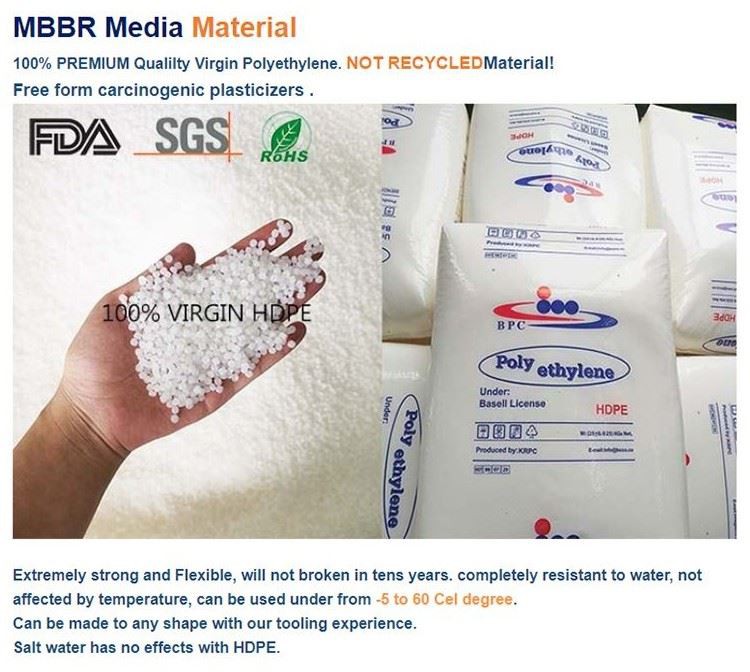
The MBBR media carriers' design should also give them a density close to the wastewater's density. The right density promotes even dispersal throughout the tank and ensures thorough waste digestion. Different materials offer different densities - the more economical re-granulates, for instance, may have substantial fluctuations in density between carrier pieces, whereas polyethylene may provide more consistency.


N‐removal
1. If carbon source is abundant and
treatment efficiency needed is < 75 %,
pre‐DN is preferable
2. If carbon source is limited and
treatment efficiency required is
> 75 %, combined‐DN is preferable
3. If, in addition to 2., space is very
limited, post‐DN may be preferable
Choice of the process is primarily dependent on the availability of internal
the carbon source for denitrification and treatment efficiency requirement:
Hot Tags: mbbr media for sewage treatment, China, suppliers, manufacturers, factory, cheap, in stock, free sample, MBBR Bio Filter Media, Mbbr STP, Aerobic Mbbr, MBBR Bio Media, HDPE MBBR Media