




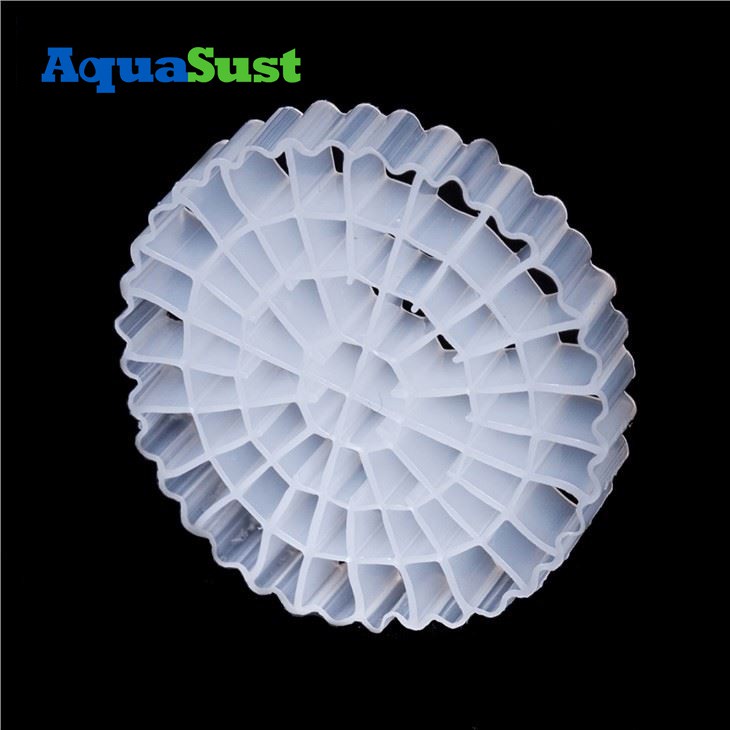
Using MBBR media is particularly advantageous because the
tiny pieces take up minimal space, are easy to maintain and digest waste efficiently. The microorganisms on the media can also automatically adjust to changes in the amount and type of waste in the water. Although MBBR systems require some monitoring, they are largely self-sufficient.
However, the MBBR biofilm reactor does not have that problem. It's a dynamic fixed-film system. The aeration system keeps the fluid and the media moving around in the tank constantly. If it doesn't have time to sit and stagnate, then it doesn't smell, same as an activated sludge system.
Rusten et al. [5] used a MBBR pilot plant to treat dairy wastewater, reaching COD removal efficiencies above 85% for organic loads up to 500 g CQO/m3 h and a hydraulic retention time (HRT) of 7 h. A MBBR was also used to treat paper mill wastewater [6] with an organic matter removal efficiency of 98.7%. Vaidhegi [7] analyzed the same type of effluent and observed a maximum degradation when using 50% of FR in 8 h, pointing out that the filling ratio is an important factor because the organic removal depends on the biomass attached to the biocarriers. De Oliveira et al. [8] also studied pulp and paper mill wastewater in a MBBR pilot plant with 20 m3, an average hydraulic retention time (HRT) of 3.3 h and a FR of 10%, is possible to observe high levels of biomass adherence. Regarding urban wastewater, Calderón et al. [9], concluded that for FR 50% a more mature and better colonized biofilm on the carrier surface would be obtained.
There you have it. Four misconceptions about MBBR in wastewater treatment. Hopefully, this clears things up for those that need it.


Strong denitrification ability
The ammonia nitrogen load is as high as 1kgNH3-N/m3·d, while the traditional activated sludge method is only 0.1~0.3kgNH3-N/m3·d, and the MBBR process can ensure that the ammonia nitrogen wastewater is stable and meets the standard
Strong impact resistance
High-concentration microorganisms and attached growth methods effectively disperse the fluctuations in incoming water quality, stable effluent, and significantly higher impact resistance than traditional activated sludge. It has strong tolerance to incoming water temperature, pH fluctuations, and toxic substances.
Simple operation control
Self-balance, no need to manually control the concentration of F/M and MLSS; there is no the problem of sludge expansion and sludge loss that are common in activated sludge
Simple maintenance
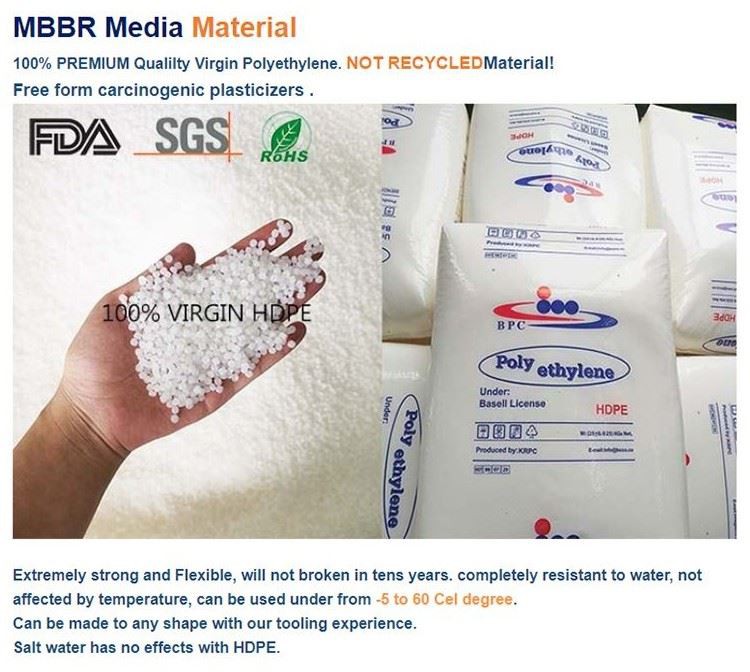
The life of the main filler and aeration system is more than 10-20 years, completely maintenance-free
Hot Tags: mbbr media for koi pond aquarium, China, suppliers, manufacturers, factory, cheap, in stock, free sample, MBBR Filter Media, Mbbr Carrier, HDPE MBBR Media, MBBR Design, , MBBR Bio Media